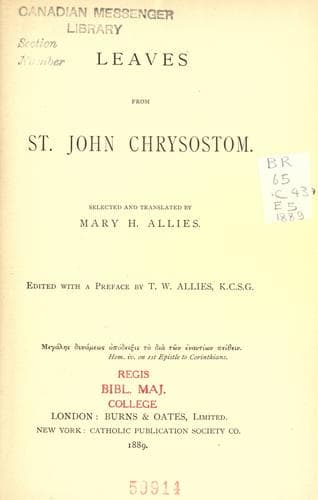
Leaves from St. John ChrysostomJohn Chrysostom, Saint
Religion
Leaves from St. John Chrysostom
John Chrysostom, Saint
Christian literature, Early; John Chrysostom, Saint, -407
which you have sold for thirty pieces of silver, O Judas; this is the
very Blood which you have just shamefully bartered to the unfeeling
Pharisees. O loving kindness of Christ! O foolish madness of Judas! On
the one hand Judas sold Him for thirty pieces of silver, whilst Christ
even after this did not refuse to give that Blood, which had been
betrayed, to the traitor for the remission of his sins, if he had so
willed. And Judas was there, and he partook of the sacred table. For, as
Our Lord had washed his feet, together with the other disciples’, so did
he eat with them of the sacred table, in order that he might have no
excuse for remaining obdurate. Our Lord did everything in His power, yet
Judas persisted in his wickedness.
But it is now time for us to approach that tremendous table. Let us,
therefore, all go to it with becoming sobriety and watchfulness. Let
there be no Judas here, no guilty man, no one infected with poison, no
man with one thing in his mouth and another in his mind. The same Christ
is now here Who prepared that table. And He it is Who is now preparing
it. For it is not a man who makes the offerings become the Body and
Blood of Christ, but the very Christ for us crucified.[21] Fulfilling
what he represents, the priest stands there, speaking those words; the
power and grace of them are God’s. _This is My Body_, he says, and this
word transforms what lies before him;[22] and just as the words,
_Increase and multiply and fill the earth_, were once spoken and endue
our nature through all time with fruitfulness, so those other words once
spoken from that time till to-day and until His coming, make the
sacrifice over each table in the churches complete. Therefore, let no
hypocrite approach, no one filled with sin, no one with poison in his
mind, that he may not receive judgment to himself, for then, too, Judas
had partaken of the oblation when the devil leapt into him; not that the
devil despised the Lord’s Body, but Judas for his shameful conduct. This
was to teach you that the devil continually attacks and assails those
who unworthily partake of the divine mysteries, as he did Judas. For
honourable things profit the good, but inflict a greater punishment on
those who abuse the use of them. I say this not to terrify but to
fortify you. Let there be no Judas, then; let no one enter in poisoned
with evil. For the sacrifice is spiritual food; and just as bodily food,
when received by a stomach which has bad humours, strengthens disease,
not from its own nature but because of that stomach’s weakness, so does
it usually happen with the spiritual mysteries. They, too, when received
by a soul full of wickedness, wither it up and corrupt it the more, not
by their own nature, but through the weakness of the participating soul.
Let no one, therefore, indulge in bad thoughts; let us rather cleanse
our mind, for we are approaching an immaculate sacrifice; let us make
our souls holy. This may be done even in one day. How? If you have
Public-domain text, read in full here on John Shaqi.
Reviews
Reviews
No reviews yet
Be the first to share your thoughts on this work.
Elsewhere in the archive
Join the Discussion
Join the discussion
Sign in to leave a comment or review.
Sign InorCreate an account