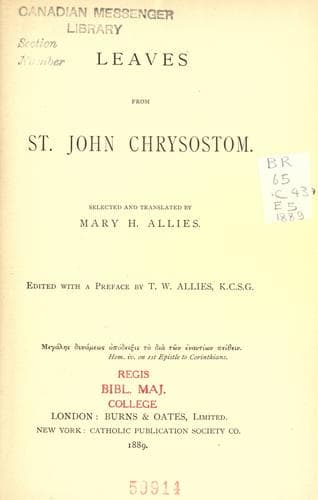
Leaves from St. John ChrysostomJohn Chrysostom, Saint
Religion
Leaves from St. John Chrysostom
John Chrysostom, Saint
Christian literature, Early; John Chrysostom, Saint, -407
martyrs receiving these spirits of ours, which are absorbed by the cares
of life, establish them in great peace and security. Just as streams of
cold water revive failing and scorched bodies, so do those
resting-places calm souls which are burnt up with foul passions. The
mere sight of them quenches evil cupidity, and wasting envy, and burning
desires, and any other trouble of the same kind, and they are superior
to treasures of great wealth. For treasures of money present many
dangers to those who find them, and when divided into many parts become
less in the distribution. Here there is nothing of this sort, for the
attainment is without dangers. Contrary to what happens in material
treasures, this division does not diminish _this_ treasure. The former,
as I said, are lessened by being divided. Now, when these are
distributed amongst many, then it is that they most of all show what
their riches are. For such is the nature of spiritual things that they
are increased by distribution, and become greater by division. Meadows
with their sight of roses and violets are not so delightful as the tombs
of the martyrs which offer to souls who gaze upon them an indestructible
and undying delight.
· · · · · · ·
The Tombs of the Servants.
(Οἱ τάφοι τῶν δοὺλων.)
(_Homilies on Second Epistle to Corinthians_, xxvi., vol. iii., p. 273.)
· · · · · · ·
Thus God has led all the saints through tribulation and distress,
helping them on the one hand whilst securing the rest against conceiving
an unduly high opinion of their merits. Thus it was in the beginning
that idolatries prevailed by the excessive admiration lavished upon men,
and in this way the Roman Senate decreed Alexander to be the thirteenth
god. For it had this authority of electing and making gods. When the
whole work of Christ became known the provincial ruler sent to enquire
whether they thought He too should be a god. They would not agree to
that, and were impatient and angry that the power of the Crucified,
bursting forth before their vote and decree, had attracted the whole
world to its own majesty. This was ordained even against their will, so
that the divinity of Christ might not be preached by vote of man, and
that He should not be looked upon as one of the many decreed by them to
be divine. For they made pugilists gods, and the creatures of Hadrian’s
infamous lust, whence, too, the city of Antinoos derives its name. For,
since death bears witness against mortal nature, the devil lighted upon
another way—the immortality of the soul, to which he joined gross
flattery, and led many into impiety. What malice! Whenever _we_ bring
forward this argument in its proper place, he destroys it; but when he
wishes to make an injurious use of it himself, he sets it up most
zealously. If anyone should ask, ‘How is Alexander a god? Did he not die
Public-domain text, read in full here on John Shaqi.
Reviews
Reviews
No reviews yet
Be the first to share your thoughts on this work.
Elsewhere in the archive
Join the Discussion
Join the discussion
Sign in to leave a comment or review.
Sign InorCreate an account