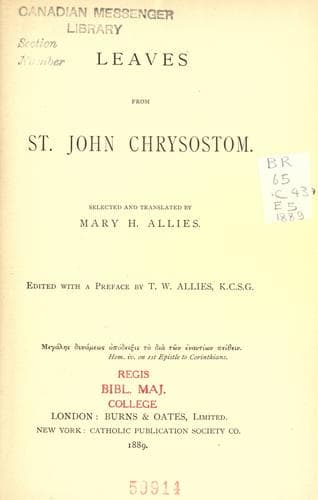
Leaves from St. John ChrysostomJohn Chrysostom, Saint
Religion
Leaves from St. John Chrysostom
John Chrysostom, Saint
Christian literature, Early; John Chrysostom, Saint, -407
and die miserably?’ He answers, ‘But his spirit is immortal’. Then you
think over in your mind the argument for immortality, and play the
philosopher in order that you may turn men away from the God of all; but
when _we_ say that this is the greatest gift of God, you persuade those
whom you cheat that we are low-minded and cringing, and nothing better
than unreasoning animals. And if we were to say that the Crucified
lives, they would indulge in great laughter at us, although the whole
universe is crying out that He does live, and did cry out of old, then
by signs, now by converts, for these successes do not belong to a dead
man; but if some one declares that Alexander lives, you believe him,
although he has no wonder whatever to bring forward in proof of it.
‘Yes, he has,’ you reply; ‘in his lifetime Alexander did many and great
deeds, for he subdued peoples and cities, and made many victorious wars,
and set up trophies.’ Now, if I am able to show you things which neither
Alexander nor any other man of his day contemplated in his lifetime,
what further proof of the resurrection do you require? That a living
man, being a king, and having an army, should carry out wars and
victories is neither astonishing nor wonderful; but to do things so
great after crucifixion and the tomb, to do them over land and sea, this
is truly awe-inspiring, and proclaims divine and infinite power. After
his death Alexander did not hinder his empire from dissolution, and when
it had disappeared did not bring it back again. How should a dead man do
this? Now, Christ set up His kingdom in dying. And why do I speak of
Christ, since He gave to His disciples also to become famous after
death? Tell me, where is Alexander’s tomb? Show it to me and say what
day he died. But the tombs of Christ’s servants are famous; they have
taken possession of the most royal city, and their days are solemnly
kept as a feast for the world. Whilst the one is unknown amongst his own
countrymen, even barbarians are familiar with the other. And the tombs
of the servants of the Crucified are more splendid than the courts of
kings, not in the greatness and beauty of the monument, though in this,
too, they are remarkable, but, what is far more, through the devotion of
those who frequent them. And he who is clothed in the royal purple
leaves his throne to embrace those tombs, and, putting off the garb of
vanity, stands as a suppliant of the saints in order to make them his
intercessors with God, and the crowned king has need of a dead
tent-maker and a fisherman as patrons. I ask you, would you dare to call
the Lord of these a dead man, Whose servants, though no longer here, are
the protectors of the kings of the earth? And you may see this happening
not in Rome alone, but also in Constantinople. For here, too, the son
thought his father, Constantine the Great, most highly honoured if he
might be buried in the vestibule of the Fisherman. What door-keepers in
Public-domain text, read in full here on John Shaqi.
Reviews
Reviews
No reviews yet
Be the first to share your thoughts on this work.
Elsewhere in the archive
Join the Discussion
Join the discussion
Sign in to leave a comment or review.
Sign InorCreate an account