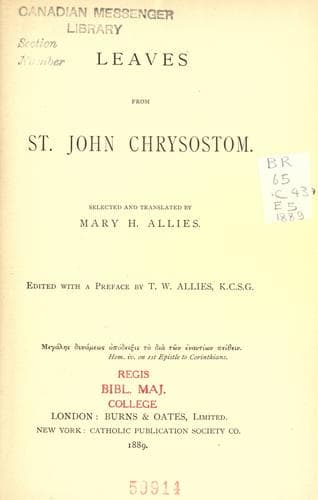
Leaves from St. John ChrysostomJohn Chrysostom, Saint
Religion
Leaves from St. John Chrysostom
John Chrysostom, Saint
Christian literature, Early; John Chrysostom, Saint, -407
_Vanity of vanities, and all is vanity._ Let us go into a churchyard;
show me now your father, show me your wife. Where is he who was clothed
in gold? Where is he who rode in his chariot? Where is he who had an
army at his command, he who had a treasury, and he who held a public
office? Where is he who killed some and cast others into prison, who
slew whom he pleased and acquitted whom he pleased? I see nothing except
bones, and the moth and the cobweb; all those things were dust and
fable, and dream and shadow, and idle talk and an epitaph—indeed, not
even an epitaph, for we see an epitaph on a figure, but in this place
not even a figure. And would that evils ended here! Now, that which
pertains to honour and feasting and great name is like a shadow and idle
talk, but that which they produce is by no means a shadow or idle talk.
Their effects remain, and will abide with us there and be evident to
all—rapacity and selfishness, fornication, adultery, and a thousand
vices of the same kind. These are not in the image nor in the ashes, but
both words and deeds are written above. With what eyes, then, shall we
look upon Christ? For if a man would not venture to see his father if he
were conscious in his own mind of sinning against him, how shall we in
that hour confront Him Who is infinitely gentler than a father? How
shall we bear Him? For we shall stand before the tribunal of Christ, and
there will be a strict scrutiny of all things. But if anyone disbelieve
in that future judgment, let him consider things as they are on
earth—those in prisons, for instance, those in mines and on dung-hills,
possessed men, madmen, those who are fighting with incurable disease,
those who are pinched by persistent poverty, those who are mated with
hunger, those who are given over to unhealable sorrow, those who are in
captivity. Men, indeed, would not now suffer these things if He did not
ordain that reward and punishment should await all those who have been
guilty of the like transgressions. And if these men incur no penalty in
this world, you must take this to yourself as a sign that there is to be
something in the next after our departure hence. For He Who is the Lord
of all would not chastise some and leave others, who had been guilty of
the same or of worse things, unchastised, if He did not reserve a
punishment for them in the next world.
· · · · · · ·
Who is the Greater?
(_Homilies on St. Matthew_, lviii., vol. ii., p. 167.)
· · · · · · ·
Public-domain text, read in full here on John Shaqi.
Reviews
Reviews
No reviews yet
Be the first to share your thoughts on this work.
Join the Discussion
Join the discussion
Sign in to leave a comment or review.
Sign InorCreate an account