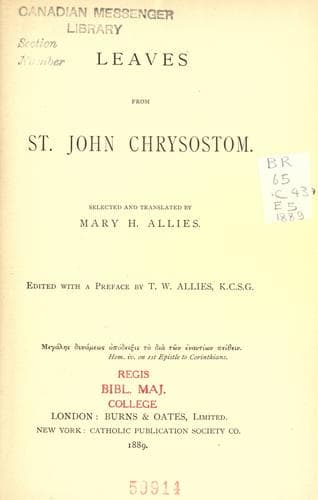
Leaves from St. John ChrysostomJohn Chrysostom, Saint
Religion
Leaves from St. John Chrysostom
John Chrysostom, Saint
Christian literature, Early; John Chrysostom, Saint, -407
behoves us all the more to take the same lesson now to heart. Together
with these considerations, we must admit that many things happen to us,
which are not according to His judgment, but the result of our own
wickedness. Say not, then, ‘Why is it that a man is rich, being bad, and
another man is poor, being just?’ We may easily explain this, and say
that neither does the just man suffer any harm from his poverty, which
is a source of greater merit to him, and that the unjust man, unless he
be converted, possesses in his riches a store of wrath, and that, in
place of chastisement, the riches of many men have often been the cause
of evil to them, and led them into a thousand abysses. But God leaves
them these riches, showing everywhere the free action of divine choice,
everywhere teaching other men not to fight nor to strive for money.
‘What, then,’ you say, ‘if a bad man becomes rich, and suffers no harm?
If a righteous man were to become rich, it would be just, but what are
we to say when a bad man does?’ That on this account he is to be pitied.
For wealth added to wickedness increases the intensity of passions. But
a man is just, and he is starving. Well, it does him no harm. But he is
bad, and starving. Well, he has his just deserts, or, rather, what is
for his good. ‘But so and so,’ you say, ‘received his wealth from
ancestors, and has squandered it on bad women and parasites, and he is
none the worse.’ How is this? Will you call him a dissolute man, and say
he is none the worse? He is a drunkard, and do you call it enjoyment? He
wastes for no good purpose, and do you look upon him as enviable? What
could a man do worse than to be making his soul an ignominy? If a body
were to be distorted or maimed, you would think it the saddest matter in
the world; yet, contemplating that man’s soul wholly maimed, do you
consider him a happy man? ‘But,’ you say, ‘he does not feel it.’ And for
this very reason he is the more to be pitied, just as men who lose their
wits are. For he who knows that he is ill will seek the physician
honestly and apply remedies; whereas he who does not know it will be
beyond cure. Tell me, then, is this the man you consider happy? But this
is not astonishing, for the majority of men are devoid of a right
estimate of things. So it is that, when chastised, we pay the extreme
penalty, and are not freed from wrath; hence come desires and
despondencies and perpetual anxieties, since, when God shows us a
painless life, that of goodness, by removing ourselves from it, we
choose another road, the way of riches and money, which is productive of
a thousand evils. We act as a man would act, who, not being able to
judge of physical beauty, but, ascribing everything to clothes and
adornment, should pass over a young woman, possessing comeliness of
body, and take to himself an ugly one, deformed and crippled, merely for
her fine dress. The great mass of men now do something of this kind in
Public-domain text, read in full here on John Shaqi.
Reviews
Reviews
No reviews yet
Be the first to share your thoughts on this work.
Join the Discussion
Join the discussion
Sign in to leave a comment or review.
Sign InorCreate an account