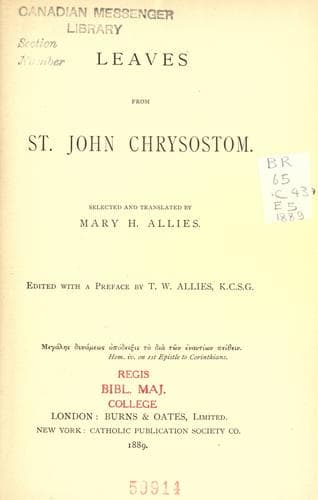
Leaves from St. John ChrysostomJohn Chrysostom, Saint
Religion
Leaves from St. John Chrysostom
John Chrysostom, Saint
Christian literature, Early; John Chrysostom, Saint, -407
shines here, but it escorts those who follow it to that heavenly
country. Whenever men see you looking down upon all present things, and
holding yourselves in readiness for eternal ones, your works will
convince them better than any argument. Who so foolish as not to deduce
a clear proof of the future life when he sees a man, thinking yesterday
only of luxury and money-making, giving up everything, freeing himself
from all cares, and stretching out his hand towards hunger, and poverty,
and hardship, and dangers, and blood-shedding, and a violent death,
towards everything which seems an evil? But if we are wholly engrossed
with present things, and plunge into them deeper and deeper, how are men
to be persuaded that we are looking for another home? What excuse shall
we have if the fear of God cannot do among us that which human fame did
amongst Greek philosophers? Some of them also gave up money and despised
death, in order to be a spectacle to men, and so their hopes were vain.
What can be said for us with these things before us, and so great a
philosophy being unfolded, that we cannot do even what they did, but are
destroying ourselves and others too? For a heathen who acts against his
conscience does not do the same harm as a Christian who thus acts, and
most justly. Their reputation is corrupt, whereas ours, through God’s
goodness, is sacred and manifest even amongst impious men. Consequently,
whenever they want particularly to reproach us, and to make their
accusation more telling, they bring this additional charge against us:
‘So and so is a Christian,’ which they would not do if they had not a
great opinion of Christian teaching. Have you not heard how many and
what great things Christ enjoined? Now, how can you observe one of those
commandments when, forgetting the rest, you go about investing your
money, looking greedily after interest, involving yourself in lawsuits,
buying herds of slaves, preparing silver plate, laying up stores of
fields and houses, and quantities of furniture? And would that this were
all! When you add iniquity to these inopportune pursuits—encroaching
upon the land of others, pulling down houses, aggravating poverty,
increasing hunger—how will you be able to mount up to those gates? But
supposing that you are merciful to the poor, I know what this means, and
it again will call for a great expiation hereafter. For if you are
merciful through conceit or vainglory, so that you gain no merit even
from good works, what could be more wretched than to be shipwrecked in
harbour? In order to prevent this from happening, seek not a reward from
me when you have done a good action, so that God may be your debtor.
_Lend_, He says, _to him from whom you expect no return_.
· · · · · · ·
The Tongue a Royal Power.
(_Homilies on St. Matthew_, li., p. 76.)
· · · · · · ·
Public-domain text, read in full here on John Shaqi.
Reviews
Reviews
No reviews yet
Be the first to share your thoughts on this work.
Join the Discussion
Join the discussion
Sign in to leave a comment or review.
Sign InorCreate an account