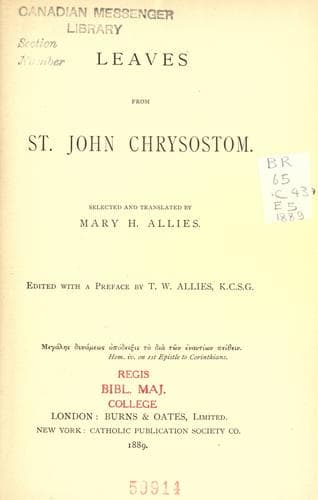
Leaves from St. John ChrysostomJohn Chrysostom, Saint
Religion
Leaves from St. John Chrysostom
John Chrysostom, Saint
Christian literature, Early; John Chrysostom, Saint, -407
But John speedily renounced this and all worldly renown. He practised a
most strictly ascetic life, and gave himself up to the study of the
Christian religion. He was a pupil of that Diodorus, afterwards bishop
of Tarsus, who was then held in high repute as a Scripture commentator.
He was also under St. Meletius, patriarch of Antioch. From him he
received baptism in 369, at the age, therefore, of twenty-two years; and
the minor order of Lector three years later. The bishops who met at
Antioch in 373 designated him, with his friend Basil, for the episcopal
dignity. In his humility he took flight to the anchorets who dwelt in
the mountains near Antioch. With them he spent four years, and two years
after that in a cavern, until his health failed, and he was obliged to
return to Antioch. Here the patriarch Meletius made him a deacon in 380;
and his successor Flavian gave him the priesthood in 386, in his
fortieth year, and named him to be preacher in the cathedral.
Then during ten years the great see of the East wondered at the
eloquence, the teaching, and the zeal of the greatest preacher it had
known. In her sorest time of need he was at hand to comfort and support
the city of his birth. When a great riot broke out, and led the citizens
in their haste and anger to insult the statues of the emperor Theodosius
and his wife, the most pious Flaccilla, and Antioch trembled lest this
act of treason should be followed by summary destruction; when her
patriarch Flavian hurried across the five hundred miles to
Constantinople, that if possible he might soften the wrath of the
emperor before the bolt was launched, St. Chrysostom preached some of
his most famous sermons, those entitled, ‘On the Statues’. He kept up
the courage of the fainting people, and when Flavian returned with a
pardon which left untouched the privileges of the city, the preacher
shared with the patriarch the gratitude of those who were saved.
Public-domain text, read in full here on John Shaqi.
Reviews
Reviews
No reviews yet
Be the first to share your thoughts on this work.
Join the Discussion
Join the discussion
Sign in to leave a comment or review.
Sign InorCreate an account