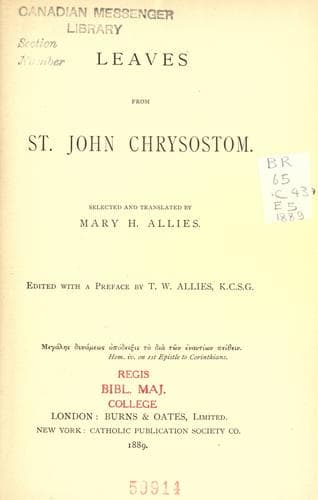
Leaves from St. John ChrysostomJohn Chrysostom, Saint
Religion
Leaves from St. John Chrysostom
John Chrysostom, Saint
Christian literature, Early; John Chrysostom, Saint, -407
And what is your excuse? ‘Who has ever come,’ you say, ‘and told us
about the next world?’ No man ever did; but God, Who is the most worthy
of belief, has revealed these things. ‘But we cannot see them.’ Neither
can you see God; and do you doubt His existence because you cannot see
Him?’ ‘I believe in it most thoroughly,’ you say. Now, then, if an
unbeliever ask you, ‘Who has ever come from heaven and told us these
things?’ what will you answer? How do you know that there is a God?
‘From visible things,’ you reply; ‘from the order which is in the whole
creation; from the fact that this is evident to all.’ Therefore, apply
the same argument to that which concerns judgment. ‘How am I to do
this?’ you ask. I will tell you, and you will say if I am right. Is God
just, and does He give to each one according to his works, or, on the
contrary, is it His wish that the wicked should do well and feast, and
the good be in trouble and want? ‘Certainly not,’ you say; ‘for not even
a man would suffer this.’ Then where are those who are upright here to
enjoy good things? Where are the wicked to suffer, if there is to be no
future life and no retribution after this world? Do you see that so far
it is one against one, and not two things instead of one? I am showing
you that the just will have not one thing rather than another, but two
things rather than nothing, and that with sinners and those who feast
here just the reverse is the case. For those who feast in this world
have not even one thing against another, but those who persevere in
virtue have two things instead of nothing. Who will be in
refreshment—those who misuse this present life or those who lead an
ascetic one? You say the former, but I point out the latter, and call in
as witnesses those very people who have enjoyed present things, and they
will not be ashamed of what I am going to say. For they have often
cursed match-makers and the day on which the marriage-tie was completed,
and have envied the unmarried. Many young men, who could easily have
married, have desisted for no other reason except its irksomeness. I say
this, not in disparagement of marriage—for it is honourable—but against
those who misuse it. For if married people have often called their life
insupportable, what shall we say of those who have fallen into the
abysses of lust, and who have led a life more slavish and miserable than
any captivity?—of those who have rotted in luxury, and drawn down a
hundred disorders upon their body? ‘Still,’ you answer, ‘it is pleasant
to be somebody.’ Nothing in the world is bitterer than this servitude.
The vain man and he who wishes to please all-comers is more servile than
any slave; whereas he who looks down upon vainglory is exalted above
all, and troubles himself not with what others say. ‘But having money is
delightful.’ We have often shown you that those are in greater plenty
and refreshment who have given up these things and are rather possessors
of nothing.
Public-domain text, read in full here on John Shaqi.
Reviews
Reviews
No reviews yet
Be the first to share your thoughts on this work.
Elsewhere in the archive
Join the Discussion
Join the discussion
Sign in to leave a comment or review.
Sign InorCreate an account