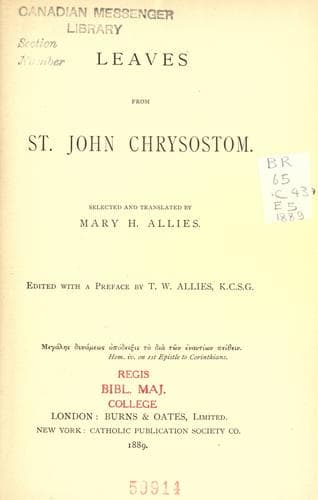
Leaves from St. John ChrysostomJohn Chrysostom, Saint
Religion
Leaves from St. John Chrysostom
John Chrysostom, Saint
Christian literature, Early; John Chrysostom, Saint, -407
‘But drunkenness is pleasant.’ Who would say so? Therefore,
if poverty is pleasanter than riches, the unmarried rather than the
married life, obscurity rather than reputation, fasting than feasting,
it follows that those have the most who do not cleave to present things.
I mean that the one, although he may be torn with numberless cares,
rests on a good hope; whereas the other, even if he enjoy luxury a
thousand times over, has fear of the future to spoil and mar his
pleasure. And this is indeed not a slight punishment, as it is
destructive to feasting and enjoyment. Together with these there is a
third sort of punishment. What is this? That earthly feasting is seen to
have no real existence, since nature and the action of time disprove it;
whereas eternal things not only do exist, but remain unchanged. Do you
see that it is not only two things against nothing, but three, five,
ten, twenty, or a thousand against nothing. In order to teach you this
from an example, take the case of Dives and Lazarus: the one enjoyed the
present life and the other eternal life. Now, does it seem to you that
you can set the one thing against the other: to be chastised for ever
and to suffer hunger for a short time; to be sick in a perishing body,
and to be burnt in a fierce fire with an immortal body; to be crowned,
and to feed on eternal goods after short suffering, and to be tortured
endlessly after a brief enjoyment of temporal things? Who would say so?
What would you have me reckon? Quantity, quality, order, God’s
determination respecting each of us? How long will you speak as an
insect might who is always wallowing in the mire?
It does not belong to consistent men to throw away so precious a soul
for anything whatsoever, when a little labour is required to conquer
heaven. Shall I show you by another example that a formidable tribunal
is awaiting us there? Open the door of your conscience and see the judge
who is sitting in your mind. If you exercise judgment upon yourself,
selfish as you are, and could not bear the judgment not to be just, how
much more will God have a care for the righteous, and judge every man
impartially rather than allow all things to be carried out for nothing
and in vain! Who, indeed, would say this? No man whatsoever, but
heathens, barbarians, poets, philosophers, and all the human race will
agree with us in these matters, if not in the same way, and will admit
that there is some kind of tribunal in hell, because the thing is so
clear and evident.
Public-domain text, read in full here on John Shaqi.
Reviews
Reviews
No reviews yet
Be the first to share your thoughts on this work.
Elsewhere in the archive
Join the Discussion
Join the discussion
Sign in to leave a comment or review.
Sign InorCreate an account