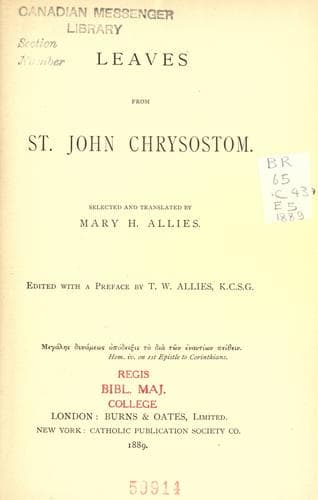
Leaves from St. John ChrysostomJohn Chrysostom, Saint
Religion
Leaves from St. John Chrysostom
John Chrysostom, Saint
Christian literature, Early; John Chrysostom, Saint, -407
Thus, at fifty years of age, St. Chrysostom was placed, not only without
seeking for it, but against his wishes, upon that see which, through the
residence of the emperor, was already become the most conspicuous of
episcopal thrones in the East. From the moment that Constantine,
sixty-seven years before, had made Byzantium Nova Roma, and founded, in
fact, a new empire, all the ambitious spirits among the prelates of the
East sought to seat themselves on that perilous height. This new centre
of temporal power was from that time forth the centre of trouble,
heresy, and disaster to the Church. Eusebius left his former see,
Nicomedia, to possess it, and to be the emperor’s bishop. One after
another Arian heretics succeeded. In 379, when the small number of
Catholics remaining in the new capital invited St. Gregory Nazienzen to
come to their aid, he could only open in a private room a small church,
which he called by the significant name of Anastasia, the Resurrection.
In that year Theodosius was promoted by the young Gratian to share his
throne, upon the destruction of his uncle Valens by the Goths. Valens
had all but destroyed both empire and Church in the East. It was the
great effort of Theodosius to restore both. In fifteen years of
unexampled energy, terrible trials, and almost miraculous success, he
did what valour, piety, and prudence could do. These years were all that
the Divine Providence had allowed him for a work almost transcending
human power; and when he died, not yet fifty years old, in 395, the
great empire of Rome, both in East and West, may be said to have fallen
into orphanage. His two sons, Arcadius and Honorius, one a youth of
nineteen and the other a boy of eleven, proved to be utterly
incompetent. Even Theodosius had failed to overcome the deep degeneracy
and rooted party spirit to which the Arian heresy had reduced the
eastern episcopate when St. Athanasius and St. Basil had been freshly
laid in their tombs. The council called by Theodosius at Constantinople
in 381 suffered St. Gregory to give up the see, which was surrounded by
envious rivals. For when Meletius, the patriarch of Antioch, died, in
presiding over that council, instead of extinguishing the Antiochene
schism by the election of Paulinus, the bishop who was already in
communion with Rome and Alexandria, according to an actual agreement,
they suffered the schism to be prolonged by the election of Flavian.
Nectarius took the place which St. Gregory had vacated, and St.
Chrysostom was called after about fifteen years to succeed to his
patriarchate.
State of Constantinople
Public-domain text, read in full here on John Shaqi.
Reviews
Reviews
No reviews yet
Be the first to share your thoughts on this work.
Join the Discussion
Join the discussion
Sign in to leave a comment or review.
Sign InorCreate an account