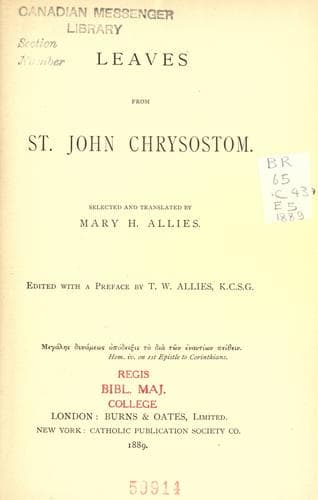
Leaves from St. John ChrysostomJohn Chrysostom, Saint
Religion
Leaves from St. John Chrysostom
John Chrysostom, Saint
Christian literature, Early; John Chrysostom, Saint, -407
‘And why,’ you ask, ‘does He not chastise in this world?’ In order that
He may show forth His own long-suffering, and give us an opportunity of
salvation by contrition; that He may not use harshness with our race,
nor deprive of salvation those who may be saved by a perfect conversion.
If He immediately chastised sins and destroyed sinners, how would Paul
have been saved or Peter, the chief teachers of the world (οἱ κορυφαῖοι
τῆς οἰκουµένης διδάσκαλοι)? How would David have reaped salvation from
his repentance? or the Galatians? or many others? This is why He does
not demand the payment of every penalty here, but some of the whole
number, nor all there, but one man pays in this world and another in the
next, in order that He may arouse the most insensible through those whom
He chastises, and prove the future state through those whom He does not
chastise. See you not how many men have received their punishment
here—those, for instance, who were buried by the tower, those whose
blood Pilate used for the sacrifices, those amongst the Corinthians who
died a premature death for partaking unworthily of the mysteries; or
again, Pharaoh, or those amongst the Jews who were slaughtered by the
Gentiles, or so many others then, and now, and at all times? And, again,
many great sinners have departed hence without paying any penalty here,
like the rich man in Lazarus’ case, and numerous others. This he does,
and so leads unbelievers to future things, and makes believers more
fervent. _For God is a just, and a strong, and a long-suffering judge,
and remembers not His anger day by day._ Yet, if we misuse His
long-suffering, a time will come when He will be patient no more, and
will instantly apply the penalty. Let us not then encounter chastisement
during endless ages for the enjoyment of one moment, which is our
present life, but let us labour during this critical moment that we may
be crowned for ever. Do you not see that this is how the majority of men
act in worldly things? And they choose a short labour in preference to a
long rest, even if the issue be unfavourable to them. Here there is
equality of labour and gain, or, on the other hand, there is often
endless labour and a small harvest, or none at all; whereas in the case
of the kingdom the travail is little, and the pleasure great and
never-ending. For consider, the husbandman toils all the year round, and
towards the end of it he is often defrauded of the fruits of his many
labours. Again, the sailor and the soldier are in wars and toils till
extreme old age, and it often chances that each dies, the one without
his wealth of cargoes, the other losing his life as well as victory on
the battlefield. Now, tell me what excuse shall we have if we choose
labours in worldly things, that we may rest for a while, or not even
that, because hope is uncertain, whereas in spiritual things we do the
very contrary, and draw down upon us an unspeakable chastisement for the
sake of short ease?
Public-domain text, read in full here on John Shaqi.
Reviews
Reviews
No reviews yet
Be the first to share your thoughts on this work.
Elsewhere in the archive
Join the Discussion
Join the discussion
Sign in to leave a comment or review.
Sign InorCreate an account