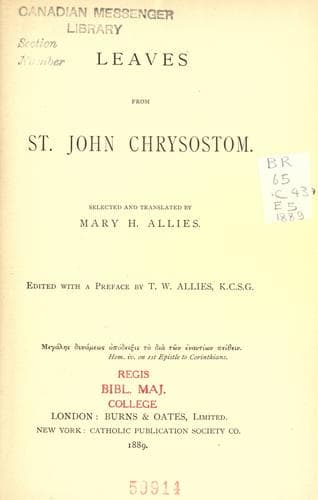
Leaves from St. John ChrysostomJohn Chrysostom, Saint
Religion
Leaves from St. John Chrysostom
John Chrysostom, Saint
Christian literature, Early; John Chrysostom, Saint, -407
Blasphemy has a present penalty, and causes our
destruction over and above what we have suffered. Have you lost money?
If you have given thanks, you have gained your soul and won greater
riches for yourself, and propitiated God the more; but, if you have
blasphemed, you have destroyed your own salvation without gaining any of
those things, and have slain your own soul.
The Folly of the Cross.
(_Homilies on First Epistle to Corinthians_, xiv., vol. ii., p. 36.)
· · · · · · ·
Showing the power of the Cross, St. Paul says: _The Jews too ask for
signs, and the Greeks seek after wisdom: but we preach Christ crucified,
a scandal to the Jews, a folly to the Gentiles, but to those who are
called, both Jews and Gentiles, Christ the power of God and the wisdom
of God_. There is a deep meaning in these words. For he wishes to say
how God conquered by contraries, and that the promulgation of the Gospel
does not come from man. What he says amounts to this. When we say to the
Jews, ‘Believe,’ they reply, ‘Raise up the dead, cure those who are
possessed, show us signs’. How do we answer these things? By saying,
that He Whom we preach was crucified and died. This was sufficient not
only not to move those who did not wish to be moved, but also to repulse
those who had the will; yet still He is not repulsed, but draws men
after Him, and conquers and gets the better of them. Again, the Gentiles
demand of us eloquent discourses and elaborate reasonings, and we reply
to them also by preaching the Cross, and that which seems to be weakness
to the Jews, the Gentiles consider folly. Now, when we not only do not
offer them what they ask for, but the very contrary, for the Cross not
only does not seem to be a sign tested, according to human reason, but
the destruction of signs: not only not a manifestation of power, but a
proof of weakness: not only not an embodiment of wisdom, but a
personification of folly; when, then, those who look for signs and
wisdom not only do not receive what they seek, but listen to things
which are the exact contrary of their desires, and, furthermore, are
persuaded by them, is not the power of Him Who is preached beyond words?
It is as if some one were to show those who are tossed on the waves and
longing for harbour, not the land, but a more angry sea, would he induce
them to follow him? Or if a physician were to tell a man broken by pain
and desiring remedies that he will restore health, not by medicine but
by again using the knife, would his patient yield himself to his
guidance? This implies very great power. So the Apostles made their way
not only by signs, but by a line of action seemingly in opposition with
signs, as Christ had done in the case of the blind man. For wishing to
cure him, He used a course which increased the affliction, as He put
clay upon his eyes. Just, then, as He cured the blind man by putting
Public-domain text, read in full here on John Shaqi.
Reviews
Reviews
No reviews yet
Be the first to share your thoughts on this work.
Elsewhere in the archive
Join the Discussion
Join the discussion
Sign in to leave a comment or review.
Sign InorCreate an account