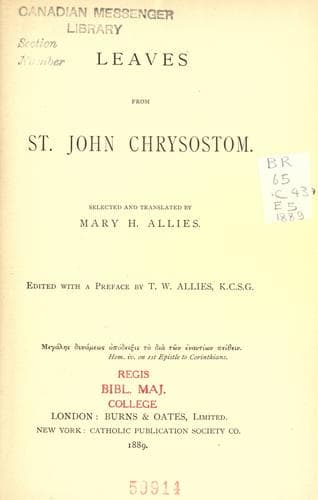
Leaves from St. John ChrysostomJohn Chrysostom, Saint
Religion
Leaves from St. John Chrysostom
John Chrysostom, Saint
Christian literature, Early; John Chrysostom, Saint, -407
clay upon him, so he drew the world to Himself through the Cross, which
indeed was an increase, not a removal of scandal. So He acted in the
Creation, preparing contraries by contraries. He built up with sand the
limits of the sea, curbing the strong with the weak; He placed the earth
upon the water, causing that which was hard and firm to be upborne by
flowing and liquid matter. Again, through the prophets He made iron
float with a little wood. Thus He drew the world after Himself through
His Cross. For as water supports the earth, so the Cross supports the
world. Therefore it is a great proof of power and wisdom to persuade by
contraries. And if the Cross seems to be a subject of scandal, still not
only it does _not_ scandalise, but it draws to itself. St. Paul had all
these things in his mind and was struck with astonishment when he said
that _the folly of God is wiser than man, and the weakness of God is
stronger than man_, applying this folly and this weakness to the Cross,
not that it was really foolish and weak but that it seemed so: for he
answers them according to _their_ estimate. That, in fact, which
philosophers had been unable to do by their reasonings was effected by
this apparent folly. Now who was the wiser? He Who persuaded many, or he
who persuaded a few—or rather no one? He Who convinced man of the
greatest things, or he who used his powers of persuasion about things
which do not exist at all? How Plato and his school laboured about the
line, the angle, and the point, and about even numbers and odd numbers,
and about their being equal and unequal, discoursing to us about such
like cobwebs, for such things are less profitable to our life than even
cobwebs, and so helping us neither much nor little, he came to the end
of his life.
How he wearied himself to show that the spirit is immortal, and did he
not die without making any clear statement or convincing a single man
amongst his disciples? But it was through unlearned men that the Cross
brought conviction, and drew the world to itself. It spoke to men, not
of chance things, but of God, and of piety in the truth, of the Gospel
polity, of future judgment, and it made uncouth men and unlearned men
philosophers.
Public-domain text, read in full here on John Shaqi.
Reviews
Reviews
No reviews yet
Be the first to share your thoughts on this work.
Elsewhere in the archive
Join the Discussion
Join the discussion
Sign in to leave a comment or review.
Sign InorCreate an account