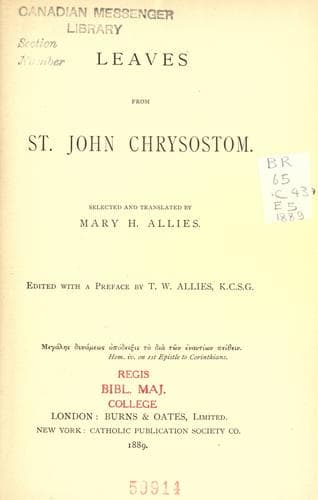
Leaves from St. John ChrysostomJohn Chrysostom, Saint
Religion
Leaves from St. John Chrysostom
John Chrysostom, Saint
Christian literature, Early; John Chrysostom, Saint, -407
_But some one asks, how are the dead to be raised to life? With what
sort of body will they come? Senseless man, that which thou sowest is
not quickened, except it die first._ Whereas the Apostle is everywhere
so gentle and humble, he makes use of stronger language in this place on
account of the adversaries’ unreasonableness. Nor is this enough but he
adds arguments and examples, and in this way gets the better even of the
most contentious. He had already said: _Whereas by man came death, by
man came also the resurrection from the dead_; and now he dissipates an
opinion prevalent amongst heathens. And consider again how he cuts away
that which is most plausible about it. He did not say, ‘_you_ ask,’ but
made the adversary indefinite, that, using strong language with effect,
he might not unduly crush his hearers. He stated two difficulties: the
manner of the resurrection and the quality of bodies. And indeed they
were in doubt concerning both points by their words: ‘How can that which
is dissolved rise again?’ and, ‘With what sort of body will they come?’
How, _with what sort of body_? Will it be like this corruptible mortal
body, or like some other? Then, to show that they are not seeking to
clear up doubtful points but to dispute what is indisputable, he uses
still stronger language, saying, _Foolish man, that which thou sowest is
not vivified unless it dieth_.
This is also our way of answering those who call in question what is
indisputable. Why, for instance, does he not at once take refuge in the
power of God? Because he is talking to unbelievers. Whenever he has to
deal with believers he is in no great need of arguments. For instance,
saying in another place that _He shall transform the body of your
humility into becoming conformed to the body of His glory_, and showing
forth something further than the resurrection, he made use of no
examples, but, instead of any proof, brought forward the power of God,
adding, _according to the efficacy of His power and to bring all things
into subjection to Him_. Here, however, he sets arguments in motion. For
since he provided this one from Scripture, he used the same with
authority against those who did not believe in the Scriptures, and said:
_Foolish man, that which thou sowest_; that is, you see from what you
yourself do day after day the proof of these things, and do you still
doubt? This is why I call you foolish, that you ignore what happens
every day to yourself, and that whereas _you_ can work a resurrection,
you doubt concerning God; therefore he said most emphatically: _That
which thou sowest_; you, that is, who are a mortal and corruptible man.
Public-domain text, read in full here on John Shaqi.
Reviews
Reviews
No reviews yet
Be the first to share your thoughts on this work.
Elsewhere in the archive
Join the Discussion
Join the discussion
Sign in to leave a comment or review.
Sign InorCreate an account