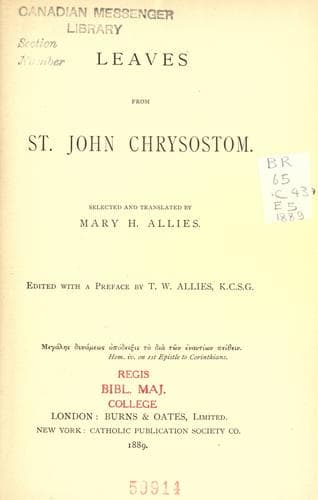
Leaves from St. John ChrysostomJohn Chrysostom, Saint
Religion
Leaves from St. John Chrysostom
John Chrysostom, Saint
Christian literature, Early; John Chrysostom, Saint, -407
And see how the words he uses bring home the point in question. _It is
not vivified_, he says, _unless it dieth_. Passing over the terms which
are proper to seeds, such as the sprouting and growth and rotting and
withering, he takes those points which correspond to our flesh, the
‘vivifying’ and ‘death,’ which belong properly not to seeds but to
bodies. And he does not say that it is vivified after dying, but what is
more, that it is quickened _because_ it has died. You see how, as I am
always saying, he brings his argument as a proof against itself. That
which they made out as conclusive against the resurrection _he_ makes an
earnest of it, for they said, ‘He will not rise because he is dead’.
Now, how can you meet this? If, indeed, he had not died, neither would
he rise again, and _because_ he has died, therefore he rises again. In
the same way Christ points this out still more clearly, saying: _If the
grain of wheat, falling into the earth, doth not die, it remaineth
alone, but if it dieth, it beareth much fruit_; so here, in illustrating
this example, Paul does not say that it does not live, but that it is
not ‘quickened,’ making again the power of God his theme, and showing
that it is He Who does all, not the properties of the soil. And why did
he not at once speak of something more personal—I mean of human seed?
For our coming into the world also begins in corruption just as that of
the corn does. It was because it was still stronger in our case than in
the latter. What he wants is something quite perishable: the corn was
partially so, and that is why he introduced it. Besides, the human seed
proceeds from a living person, and falls into a living womb, but here
the seed is cast into the earth, not into a living body, and becomes
dissolved in it, just as in the case of the mortal body. Thus the
example was the more pertinent.
Public-domain text, read in full here on John Shaqi.
Reviews
Reviews
No reviews yet
Be the first to share your thoughts on this work.
Elsewhere in the archive
Join the Discussion
Join the discussion
Sign in to leave a comment or review.
Sign InorCreate an account