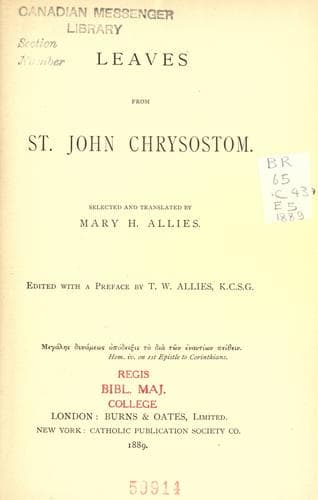
Leaves from St. John ChrysostomJohn Chrysostom, Saint
Religion
Leaves from St. John Chrysostom
John Chrysostom, Saint
Christian literature, Early; John Chrysostom, Saint, -407
to which he added pertinently, _but bare grain, as of wheat, or of some
of the rest_. That is to say, _thou sowest not the body which shall be_:
the corn, for instance, as we look upon it, with stalk and ear, _but
bare grain, as of wheat, or of some of the rest. And God giveth it a
body as He wills._ ‘Granted,’ you say, ‘but in that case the work of
nature comes in.’ Tell me, what sort of nature? Here it is God Who works
everything, not nature, nor soil, nor rain. Hence He makes this clear,
and leaving earth, rain, air, sun, and the labour of the agriculturist
out of the question, adds: _God giveth it a body as He willeth_. Seek
not, therefore, to understand or to scrutinise the why and the how, when
you hear that God’s power and good pleasure come into play. _And to each
of the seeds its own body._ Why then another? He gives each his own. So
that when St. Paul says, _Thou sowest not the body which shall be_, he
does not mean that He raises up something else of a different substance,
but something better and more splendid: _To each one of the seeds its
own substance_.
· · · · · · ·
The Resurrection in Creation.
(_Homilies on First Epistle to Corinthians_, xvii., vol. ii., p. 199.)
· · · · · · ·
Let no man disbelieve in the Resurrection, but if any man be in doubt,
let him consider what great and wondrous things God made out of nothing,
and receive _them_ as a pledge of _it_. That, indeed, which has already
taken place is much more marvellous and awe-inspiring. For, consider, He
took the earth and moulded it, and made man and earth which was not
before. How, then, did earth become man? How did the earth come out of
nothing? How all those things proceeding from the earth, the endless
families of unreasoning animals, of seeds and plants, which came forth
without travail, without rains falling upon them, with no apparent
cultivation, neither oxen nor plough nor anything else contributing
towards their production. On this account He brought forth in the
beginning, from that which was without life and without substance, such
great things, both of the physical and animal creation, in order that He
might teach you from the first the doctrine of the Resurrection. For
this is far more difficult than the Resurrection. It is not indeed an
equivalent proof of power to rekindle a smouldering flame and to light a
fire by invisible means; it is not the same thing to restore a
dilapidated house and to build one from the foundations. In the one
case, if there was nothing else, there was material to work from; but in
the other not even that. Consequently, He began by the more difficult
thing, in order that you might receive that which was easier. I say
_more difficult_, not that it was so to God, but according to our manner
of reasoning. For nothing is hard to God; and just as the sculptor who
makes one statue can as easily produce a thousand, so it is as easy to
Public-domain text, read in full here on John Shaqi.
Reviews
Reviews
No reviews yet
Be the first to share your thoughts on this work.
Elsewhere in the archive
Join the Discussion
Join the discussion
Sign in to leave a comment or review.
Sign InorCreate an account