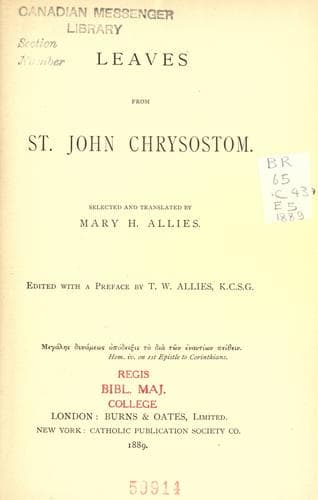
Leaves from St. John ChrysostomJohn Chrysostom, Saint
Religion
Leaves from St. John Chrysostom
John Chrysostom, Saint
Christian literature, Early; John Chrysostom, Saint, -407
_And the sower does not sow the body which shall be._ That which has
been said so far is to answer the objection, ‘How shall they rise
again?’ this is directed to the question, ‘What sort of body will they
have?’ Now what is, _Thou sowest not the body which shall be_?—not a
full ear of corn, nor new grain. For here they were not disputing the
resurrection, but the manner of the resurrection, what sort of body the
risen one should be, whether like our present one, or more perfect and
splendid, and he embraces both points in the same example, and shows
that it is a much more perfect one. But heretics, admitting none of
these things, retort by saying that it is one body which is sown and
another which is risen. How, then, could it be a resurrection since a
resurrection refers to something sown? What is there wonderful or awful
about the victory over death, if one thing is sown and another thing
rises again? Death would not seem to be giving back the trophy which he
took. How would the illustration be carried out in what they say? Not
one substance is sown and another raised up, but the same substance in
an improved condition. Supposing that Christ did not resume the same
body when He became the first fruits of the risen; but according to you
He cast off His former body although it was without sin, and took
another. Whence, then, did this other come from? The first was from the
Virgin. Whence the second? Do you see what an unnatural argument it is?
Why did He show the marks of the nails? Was it not because He wished to
prove that the same body which was crucified had also risen again? How
does the sign of Jonas affect him? I presume that it was not one Jonas
who was swallowed up, and another who was washed to land again? And what
were His words? _Destroy this temple, and in three days I will raise it
up again._ It is plain that He _did_ raise up this temple when
destroyed. Therefore, the Evangelist went on to say that _He was
speaking of the temple of His body_. Now, what does St. Paul say? _Thou
sowest not the body which shall be_; that is, not the ear of corn, which
is the same and not the same: the same as being the same substance, and
not the same inasmuch as it is perfected, and whereas the same substance
remains, it rises in renewed vigour. If this were not the case, He would
not have required a resurrection at all, unless He had meant to raise up
something better. Why, indeed, should He dissolve the house if He did
not intend to make it a more striking dwelling-place? This, therefore,
St. Paul said in answer to those who look upon it as corruptible.
Moreover, lest any man should imagine that he means another body, he
softens the difficulty, and himself interprets it so that his hearer
should not in any way bring the wisdom of the world to bear upon the
point. What need is there, then, of our arguments? Listen to his
interpretation of the words, _Thou sowest not the body which shall be_,
Public-domain text, read in full here on John Shaqi.
Reviews
Reviews
No reviews yet
Be the first to share your thoughts on this work.
Elsewhere in the archive
Join the Discussion
Join the discussion
Sign in to leave a comment or review.
Sign InorCreate an account