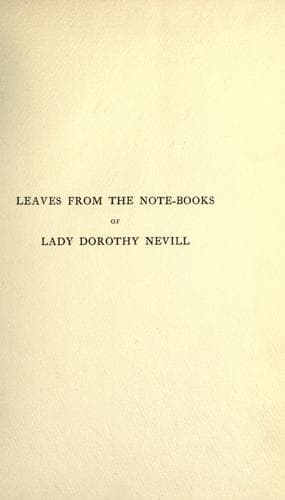
Leaves from the Note-Books of Lady Dorothy NevillNevill, Dorothy, Lady
History
Leaves from the Note-Books of Lady Dorothy Nevill
Nevill, Dorothy, Lady
Great Britain -- Social life and customs -- 19th century; Great Britain -- Social life and customs -- 20th century
Since the days when as a child I first knew London the outward aspect of
most of the streets may be said to have completely changed. Up to within
the last twenty years the alteration was not very marked, being for the
most part gradual, but now a veritable architectural revolution seems to
be taking place. Everywhere the boxlike Georgian house is passing away,
and on all sides towering mansions with elaborate frontages in every
possible style (some indeed being little but collections of decorative
samples jumbled up together) are making their appearance. Amongst other
eccentricities modern architects seem to have an especial love for small
windows, which, considering the not over-abundant supply of sunshine and
light available in London, seem somewhat out of place. On one estate (I
believe that belonging to the Duke of Westminster), a clause in every
lease forbids the building of a house with any but windows of very
moderate dimensions. In modern street architecture uniformity seems to
have little place; it is, I fancy, considered inartistic by English
architects, who, careless of the example of Mansard (the designer of the
Place de la Concorde) and other men of the past, who were capable of
really great architectural conceptions, imagine that decoration, no
matter how exotic or inappropriate, produces a more striking effect than
that well-proportioned, dignified, and graceful uniformity of
construction to which, I fear, they are quite unable to attain. The best
modern street in the West End, I think, is Mount Street, which,
notwithstanding the diversity of style exhibited in the façades of the
houses, is a really fine street, and one, moreover, not entirely
unpicturesque. Most of the old streets in the West End are too narrow
for the lofty houses now so frequently being erected. How the occupants
of these mansions—overshadowed as they must be by other giant
constructions facing them, and for the most part only furnished with
ridiculous little windows—ever obtain any light, is a mystery which I
think their builders would be considerably puzzled to explain. The old
Georgian houses were quite devoid of any pretension to especial
decorative merit, but some of them were not lacking in a certain dignity
of proportion, whilst ample provision for the admission of light was
always to be found. The ironwork of the railings was also in some cases
extremely artistic, never erring (as almost invariably does modern
ironwork) in the direction of over-elaboration and meaningless
eccentricity.
Public-domain text, read in full here on John Shaqi.
Reviews
Reviews
No reviews yet
Be the first to share your thoughts on this work.
Elsewhere in the archive
Join the Discussion
Join the discussion
Sign in to leave a comment or review.
Sign InorCreate an account