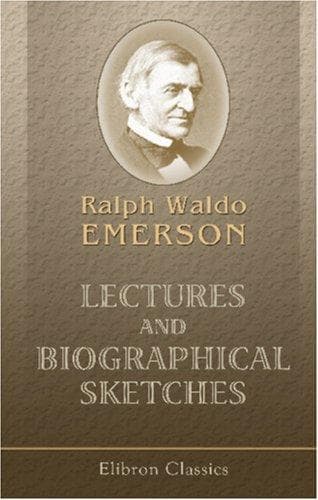
Lectures and biographical sketchesEmerson, Ralph Waldo
Philosophy
Lectures and biographical sketches
Emerson, Ralph Waldo
American essays -- 19th century; Speeches, addresses, etc., American -- 19th century
those countries have been trampled with armies and burned over: a few
summers, and they smile with plenty and yield new men and new revenues.
If churches are effete, it is because the new Heaven forms. You are
here as the carriers of the power of Nature,--as Roger Bacon, with his
secret of gunpowder, with his secret of the balloon and of steam; as
Copernicus, with his secret of the true astronomy; as Columbus, with
America in his log-book; as Newton, with his gravity; Harvey, with his
circulation; Smith, with his law of trade; Franklin, with lightning;
Adams, with Independence; Kant, with pure reason; Swedenborg, with his
spiritual world. You are the carriers of ideas which are to fashion the
mind and so the history of this breathing world, so as they shall be,
and not otherwise.
Every man is a scholar potentially, and does not need any one good so
much as this of right thought.
“Calm pleasures here abide, majestic pains.”
Coleridge traces “three silent revolutions,” of which the first was
“when the clergy fell from the Church.” A scholar was once a priest.
But the Church clung to ritual, and the scholar clung to joy, low
as well as high, and thus the separation was a mutual fault. But I
think it is a schism which must be healed. The true scholar is the
Church. Only the duties of Intellect must be owned. Down with these
dapper trimmers and sycophants! let us have masculine and divine men,
formidable lawgivers, Pythagoras, Plato, Aristotle, who warp the
churches of the world from their traditions, and penetrate them through
and through with original perception. The intellectual man lives in
perpetual victory. As certainly as water falls in rain on the tops of
mountains and runs down into valleys, plains and pits, so does thought
fall first on the best minds, and run down, from class to class, until
it reaches the masses, and works revolutions.
Public-domain text, read in full here on John Shaqi.
Reviews
Reviews
No reviews yet
Be the first to share your thoughts on this work.
Elsewhere in the archive
Join the Discussion
Join the discussion
Sign in to leave a comment or review.
Sign InorCreate an account