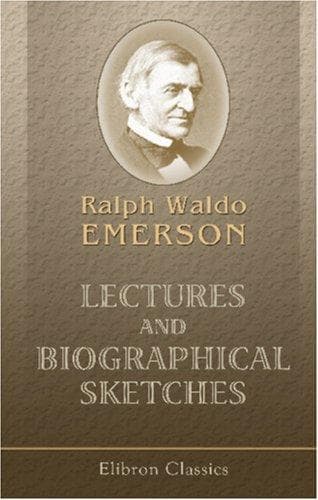
Lectures and biographical sketchesEmerson, Ralph Waldo
Philosophy
Lectures and biographical sketches
Emerson, Ralph Waldo
American essays -- 19th century; Speeches, addresses, etc., American -- 19th century
“In my youth,” said a Scotch mountaineer, “a Highland gentleman
measured his importance by the number of men his domain could support.
After some time the question was, to know how many great cattle it
would feed. To-day we are come to count the number of sheep. I suppose
posterity will ask how many rats and mice it will feed.”
Dickens complained that in America, as soon as he arrived in any of the
Western towns, a committee waited on him and invited him to deliver a
temperance lecture. Bowditch translated Laplace, and when he removed to
Boston, the Hospital Life Assurance Company insisted that he should
make their tables of annuities. Napoleon knows the art of war, but
should not be put on picket duty. Linnæus or Robert Brown must not
be set to raise gooseberries and cucumbers, though they be excellent
botanists. A shrewd broker out of State Street visited a quiet
countryman possessed of all the virtues, and in his glib talk said,
“With your character now I could raise all this money at once, and make
an excellent thing of it.”
There is an oracle current in the world, that nations die by suicide.
The sign of it is the decay of thought. Niebuhr has given striking
examples of that fatal portent; as in the loss of power of thought that
followed the disasters of the Athenians in Sicily.
I cannot forgive a scholar his homeless despondency. He represents
intellectual or spiritual force. I wish him to rely on the spiritual
arm; to live by his strength, not by his weakness. A scholar defending
the cause of slavery, of arbitrary government, of monopoly, of the
oppressor, is a traitor to his profession. He has ceased to be a
scholar. He is not company for clean people. The worst times only show
him how independent he is of times; only relieve and bring out the
splendor of his privilege. Disease alarms the family, but the physician
sees in it a temporary mischief, which he can check and expel. The
fears and agitations of men who watch the markets, the crops, the
plenty or scarcity of money, or other superficial events, are not
for him. He knows that the world is always equal to itself; that the
forces which uphold and pervade it are eternal. Air, water, fire, iron,
gold, wheat, electricity, animal fibre, have not lost a particle of
power, and no decay has crept over the spiritual force which gives
bias and period to boundless nature. Bad times,--what are bad times?
Nature is rich, exuberant, and mocks at the puny forces of destruction.
Man makes no more impression on her wealth than the caterpillar or
the cankerworm whose petty ravage, though noticed in an orchard or a
village, is insignificant in the vast exuberance of the summer. There
is no unemployed force in Nature. All decomposition is recomposition.
War disorganizes, but it is to reorganize. Weeks, months pass--a new
harvest; trade springs up, and there stand new cities, new homes, all
rebuilt and sleepy with permanence. Italy, France--a hundred times
Public-domain text, read in full here on John Shaqi.
Reviews
Reviews
No reviews yet
Be the first to share your thoughts on this work.
Elsewhere in the archive
Join the Discussion
Join the discussion
Sign in to leave a comment or review.
Sign InorCreate an account