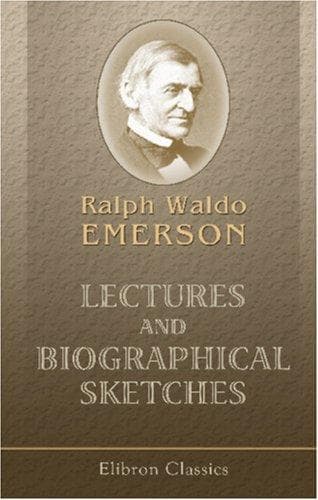
Lectures and biographical sketchesEmerson, Ralph Waldo
Philosophy
Lectures and biographical sketches
Emerson, Ralph Waldo
American essays -- 19th century; Speeches, addresses, etc., American -- 19th century
Gentlemen, I am here to commend to you your art and profession as
thinkers. It is real. It is the secret of power. It is the art of
command. All superiority is this, or related to this. “All that the
world admires comes from within.” Thought makes us men; ranks us;
distributes society; distributes the work of the world; is the prolific
source of all arts, of all wealth, of all delight, of all grandeur. Men
are as they believe. Men are as they think, and the man who knows any
truth not yet discerned by other men, is master of all other men so far
as that truth and its wide relations are concerned.
Intellect measures itself by its counteraction to any accumulation of
material force. There is no mass which it cannot surmount and dispose
of. The exertions of this force are the eminent experiences,--out of
a long life all that is worth remembering. These are the moments that
balance years. Does any one doubt between the strength of a thought
and that of an institution? Does any one doubt that a good general is
better than a park of artillery? See a political revolution dogging a
book. See armies, institutions, literatures, appearing in the train of
some wild Arabian’s dream.
There is a proverb that Napoleon, when the Mameluke cavalry approached
the French lines, ordered the grenadiers to the front, and the asses
and the _savans_ to fall into the hollow square. It made a good
story, and circulated in that day. But how stands it now? The military
expedition was a failure. Bonaparte himself deserted, and the army got
home as it could, all fruitless; not a trace of it remains. All that is
left of it is the researches of those _savans_ on the antiquities
of Egypt, including the great work of Denon, which led the way to all
the subsequent studies of the English and German scholars on that
foundation. Pytheas of Ægina was victor in the Pancratium of the boys,
at the Isthmian games. He came to the poet Pindar and wished him to
write an ode in his praise, and inquired what was the price of a poem.
Pindar replied that he should give him one talent, about a thousand
dollars of our money. “A talent!” cried Pytheas; “why, for so much
money I can erect a statue of bronze in the temple.” “Very likely.”
On second thoughts, he returned and paid for the poem. And now not
only all the statues of bronze in the temples of Ægina are destroyed,
but the temples themselves, and the very walls of the city are utterly
gone, whilst the ode of Pindar, in praise of Pytheas, remains entire.
The treachery of scholars! They are idealists, and should stand for
freedom, justice, and public good. The scholar is bound to stand for
all the virtues and all the liberties,--liberty of trade, liberty of
the press, liberty of religion,--and he should open all the prizes of
success and all the roads of Nature to free competition.
Public-domain text, read in full here on John Shaqi.
Reviews
Reviews
No reviews yet
Be the first to share your thoughts on this work.
Elsewhere in the archive
Join the Discussion
Join the discussion
Sign in to leave a comment or review.
Sign InorCreate an account