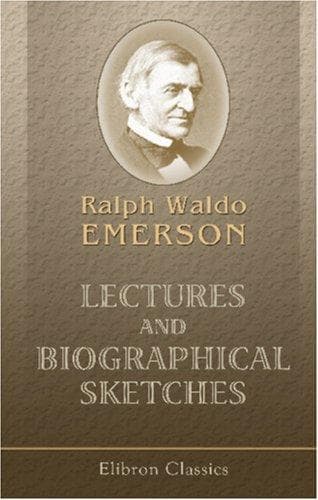
Lectures and biographical sketchesEmerson, Ralph Waldo
Philosophy
Lectures and biographical sketches
Emerson, Ralph Waldo
American essays -- 19th century; Speeches, addresses, etc., American -- 19th century
The country complains loudly of the inefficiency of the army. It was
badly led. But, before this, it was not the army alone, it was the
population that was badly led. The clerisy, the spiritual guides, the
scholars, the seers have been false to their trust.
Rely on yourself. There is respect due to your teachers, but every age
is new, and has problems to solve, insoluble by the last age. Men over
forty are no judges of a book written in a new spirit. Neither your
teachers, nor the universal teachers, the laws, the customs or dogmas
of nations, neither saint nor sage, can compare with that counsel which
is open to you. No, it is not nations, no, nor even masters, not at
last a few individuals or any heroes, but himself only, the large
equality to truth of a single mind,--as if, in the narrow walls of a
human heart, the wide realm of truth, the world of morals, the tribunal
by which the universe is judged, found room to exist.
Our people have this levity and complaisance,--they fear to offend,
do not wish to be misunderstood; do not wish, of all things, to be in
the minority. God and Nature are altogether sincere, and Art should
be as sincere. It is not enough that the work should show a skilful
hand, ingenious contrivance and admirable polish and finish; it should
have a commanding motive in the time and condition in which it was
made. We should see in it the great belief of the artist, which caused
him to make it so as he did, and not otherwise; nothing frivolous,
nothing that he might do or not do, as he chose, but somewhat that
must be done then and there by him; he could not take his neck out
of that yoke, and save his soul. And this design must shine through
the whole performance. Sincerity is, in dangerous times, discovered
to be an immeasurable advantage. I distrust all the legends of great
accomplishments or performance of unprincipled men. Very little
reliance must be put on the common stories that circulate of this
great senator’s or that great barrister’s learning, their Greek, their
varied literature. That ice won’t bear. Reading!--do you mean that
this senator or this lawyer, who stood by and allowed the passage of
infamous laws, was a reader of Greek books? That is not the question;
but to what purpose did they read? I allow them the merit of that
reading which appears in their opinions, tastes, beliefs, and practice.
They read that they might know, did they not? Well, these men did
not know. They blundered; they were utterly ignorant of that which
every boy or girl of fifteen knows perfectly,--the rights of men and
women. And this big-mouthed talker, among his dictionaries and Leipzic
editions of Lysias, had lost his knowledge. But the President of the
Bank nods to the President of the Insurance Office, and relates that
at Virginia Springs this idol of the forum exhausted a trunkful of
classic authors. There is always the previous question, How came you on
that side? You are a very elegant writer, but you can’t write up what
Public-domain text, read in full here on John Shaqi.
Reviews
Reviews
No reviews yet
Be the first to share your thoughts on this work.
Elsewhere in the archive
Join the Discussion
Join the discussion
Sign in to leave a comment or review.
Sign InorCreate an account