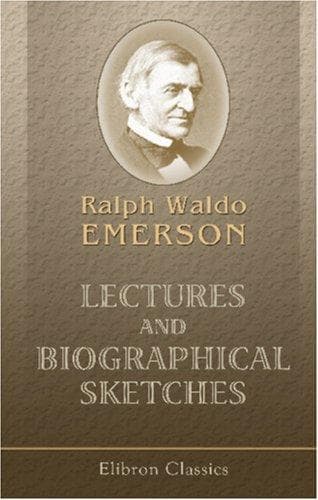
Lectures and biographical sketchesEmerson, Ralph Waldo
Philosophy
Lectures and biographical sketches
Emerson, Ralph Waldo
American essays -- 19th century; Speeches, addresses, etc., American -- 19th century
I proceed to say that the allusions just now made to the extent of
his duties, the manner in which every day’s events will find him in
work, may show that his place is no sinecure. The scholar, when he
comes, will be known by an energy that will animate all who see him.
The labor of ambition and avarice will appear fumbling beside his. In
the right hands, literature is not resorted to as a consolation, and
by the broken and decayed, but as a decalogue. In this country we are
fond of results and of short ways to them; and most in this department.
In our experiences, learning is not learned, nor is genius wise. The
name of the Scholar is taken in vain. We who should be the channel of
that unweariable Power which never sleeps, must give our diligence no
holidays. Other men are planting and building, baking and tanning,
running and sailing, heaving and carrying, each that he may peacefully
execute the fine function by which they all are helped. Shall he play,
whilst their eyes follow him from far with reverence, attributing
to him the delving in great fields of thought, and conversing with
supernatural allies? If he is not kindling his torch or collecting oil,
he will fear to go by a workshop; he will not dare to hear the music of
a saw or plane; the steam-engine will reprimand, the steam-pipe will
hiss at him; he cannot look a blacksmith in the eye; in the field he
will be shamed by mowers and reapers. The speculative man, the scholar,
is the right hero. He is brave, because he sees the omnipotence of that
which inspires him. Is there only one courage and one warfare? I cannot
manage sword and rifle; can I not therefore be brave? I thought there
were as many courages as men. Is an armed man the only hero? Is a man
only the breech of a gun or the haft of a bowie-knife? Men of thought
fail in fighting down malignity, because they wear other armor than
their own. Let them decline henceforward foreign methods and foreign
courages. Let them do that which they can do. Let them fight by their
strength, not by their weakness. It seems to me that the thoughtful man
needs no armor but this--concentration. One thing is for him settled,
that he is to come at his ends. He is not there to defend himself,
but to deliver his message; if his voice is clear, then clearly; if
husky, then huskily; if broken, he can at least scream; gag him, he can
still write it; bruise, mutilate him, cut off his hands and feet, he
can still crawl towards his object on his stumps. It is the corruption
of our generation that men value a long life, and do not esteem life
simply as a means of expressing a sentiment.
Public-domain text, read in full here on John Shaqi.
Reviews
Reviews
No reviews yet
Be the first to share your thoughts on this work.
Elsewhere in the archive
Join the Discussion
Join the discussion
Sign in to leave a comment or review.
Sign InorCreate an account