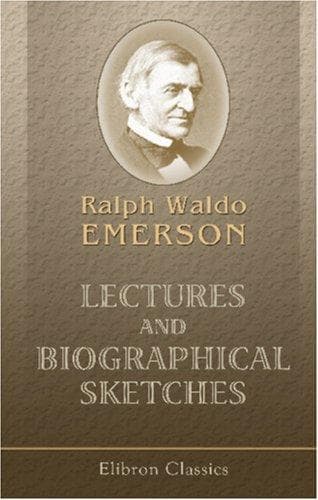
Lectures and biographical sketchesEmerson, Ralph Waldo
Philosophy
Lectures and biographical sketches
Emerson, Ralph Waldo
American essays -- 19th century; Speeches, addresses, etc., American -- 19th century
The great English patriot Algernon Sidney wrote to his father from his
prison a little before his execution: “I have ever had in my mind that
when God should cast me into such a condition as that I cannot save my
life but by doing an indecent thing he shows me the time has come when
I should resign it.” Beauty belongs to the sentiment, and is always
departing from those who depart out of that. The hero rises out of
all comparison with contemporaries and with ages of men, because he
disesteems old age, and lands, and money, and power, and will oppose
all mankind at the call of that private and perfect Right and Beauty in
which he lives.
Man is a torch borne in the wind. The ends I have hinted at made the
scholar or spiritual man indispensable to the Republic or Commonwealth
of Man. Nature could not leave herself without a seer and expounder.
But he could not see or teach without organs. The same necessity
then that would create him reappears in his splendid gifts. There is
no power in the mind but in turn becomes an instrument. The descent
of genius into talents is part of the natural order and history of
the world. The incarnation must be. We cannot eat the granite nor
drink hydrogen. They must be decompounded and recompounded into corn
and water before they can enter our flesh. There is a great deal of
spiritual energy in the universe, but it is not palpable to us until
we can make it up into man. There is plenty of air, but it is worth
nothing until by gathering it into sails we can get it into shape and
service to carry us and our cargo across the sea. Then it is paid
for by hundreds of thousands of our money. Plenty of water also, sea
full, sky full; who cares for it? But when we can get it where we want
it, and in measured portions, on a mill-wheel, or boat-paddle, we
will buy it with millions. There is plenty of wild azote and carbon
unappropriated, but it is nought till we have made it up into loaves
and soup. So we find it in higher relations. There is plenty of wild
wrath, but it steads not until we can get it racked off, shall I say?
and bottled into persons; a little pure, and not too much, to every
head. How many young geniuses we have known, and none but ourselves
will ever hear of them for want in them of a little talent!
Public-domain text, read in full here on John Shaqi.
Reviews
Reviews
No reviews yet
Be the first to share your thoughts on this work.
Elsewhere in the archive
Join the Discussion
Join the discussion
Sign in to leave a comment or review.
Sign InorCreate an account