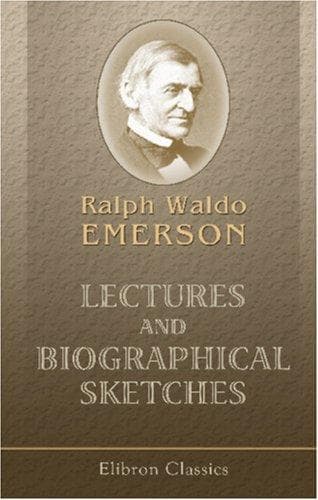
Lectures and biographical sketchesEmerson, Ralph Waldo
Philosophy
Lectures and biographical sketches
Emerson, Ralph Waldo
American essays -- 19th century; Speeches, addresses, etc., American -- 19th century
The scholar must be ready for bad weather, poverty, insult, weariness,
repute of failure, and many vexations. He must have a great patience,
and ride at anchor and vanquish every enemy whom his small arms cannot
reach, by the grand resistance of submission, of ceasing to do. He
is to know that in the last resort he is not here to work, but to be
worked upon. He is to eat insult, drink insult, be clothed and shod in
insult until he has learned that this bitter bread and shameful dress
is also wholesome and warm, is in short indifferent; is of the same
chemistry as praise and fat living; that they also are disgrace and
soreness to him who has them. I think much may be said to discourage
and dissuade the young scholar from his career. Freely be that said.
Dissuade all you can from the lists. Sift the wheat, frighten away the
lighter souls. Let us keep only the heavy-armed. Let those come who
cannot but come, and who see that there is no choice here, no advantage
and no disadvantage compared with other careers. For the great
Necessity is our patron, who distributes sun and shade after immutable
laws.
Yes, he has his dark days, he has weakness, he has waitings, he
has bad company, he is pelted by storms of cares, untuning cares,
untuning company. Well, let him meet them. He has not consented to the
frivolity, nor to the dispersion. The practical aim is forever higher
than the literary aim. He shall not submit to degradation, but shall
bear these crosses with what grace he can. He is still to decline how
many glittering opportunities, and to retreat, and wait. So shall you
find in this penury and absence of thought a purer splendor than ever
clothed the exhibitions of wit. I invite you not to cheap joys, to
the flutter of gratified vanity, to a sleek and rosy comfort; no, but
to bareness, to power, to enthusiasm, to the mountain of vision, to
true and natural supremacy, to the society of the great, and to love.
Give me bareness and poverty so that I know them as the sure heralds
of the Muse. Not in plenty, not in a thriving, well-to-do condition,
she delighteth. He that would sacrifice at her altar must not leave a
few flowers, an apple, or some symbolic gift. No; he must relinquish
orchards and gardens, prosperity and convenience; he may live on a
heath without trees; sometimes hungry, and sometimes rheumatic with
cold. The fire retreats and concentrates within into a pure flame, pure
as the stars to which it mounts.
Public-domain text, read in full here on John Shaqi.
Reviews
Reviews
No reviews yet
Be the first to share your thoughts on this work.
Elsewhere in the archive
Join the Discussion
Join the discussion
Sign in to leave a comment or review.
Sign InorCreate an account