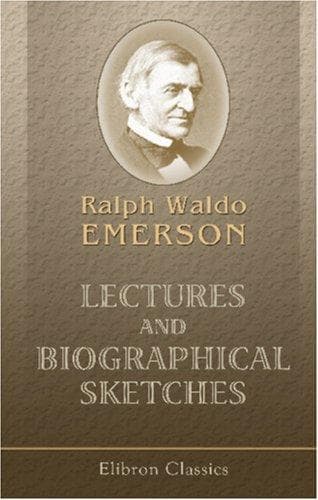
Lectures and biographical sketchesEmerson, Ralph Waldo
Philosophy
Lectures and biographical sketches
Emerson, Ralph Waldo
American essays -- 19th century; Speeches, addresses, etc., American -- 19th century
Plutarch’s popularity will return in rapid cycles. If over-read in
this decade, so that his anecdotes and opinions become commonplace,
and to-day’s novelties are sought for variety, his sterling values
will presently recall the eye and thought of the best minds, and his
books will be reprinted and read anew by coming generations. And thus
Plutarch will be perpetually rediscovered from time to time as long as
books last.
FOOTNOTES:
[Footnote 10: This paper was printed as an introduction to Plutarch’s
_Morals_, edited by Professor William W. Goodwin, Boston, 1871.]
HISTORIC NOTES OF LIFE AND LETTERS IN NEW ENGLAND.
“OF old things all are over old,
Of good things none are good enough;--
We’ll show that we can help to frame
A world of other stuff.”
FOR Joy and Beauty planted it
With faerie gardens cheered,
And boding Fancy haunted it
With men and women weird.
HISTORIC NOTES OF LIFE AND LETTERS IN NEW ENGLAND.
THE ancient manners were giving way. There grew a certain tenderness on
the people, not before remarked. Children had been repressed and kept
in the background; now they were considered, cosseted and pampered. I
recall the remark of a witty physician who remembered the hardships of
his own youth; he said, “It was a misfortune to have been born when
children were nothing, and to live till men were nothing.”
There are always two parties, the party of the Past and the party
of the Future; the Establishment and the Movement. At times the
resistance is reanimated, the schism runs under the world and appears
in Literature, Philosophy, Church, State, and social customs. It is
not easy to date these eras of activity with any precision, but in
this region one made itself remarked, say in 1820 and the twenty years
following.
It seemed a war between intellect and affection; a crack in nature,
which split every church in Christendom into Papal and Protestant;
Calvinism into Old and New schools; Quakerism into Old and New; brought
new divisions in politics; as the new conscience touching temperance
and slavery. The key to the period appeared to be that the mind had
become aware of itself. Men grew reflective and intellectual. There was
a new consciousness. The former generations acted under the belief that
a shining social prosperity was the beatitude of man, and sacrificed
uniformly the citizen to the State. The modern mind believed that the
nation existed for the individual, for the guardianship and education
of every man. This idea, roughly written in revolutions and national
movements, in the mind of the philosopher had far more precision; the
individual is the world.
Public-domain text, read in full here on John Shaqi.
Reviews
Reviews
No reviews yet
Be the first to share your thoughts on this work.
Elsewhere in the archive
Join the Discussion
Join the discussion
Sign in to leave a comment or review.
Sign InorCreate an account