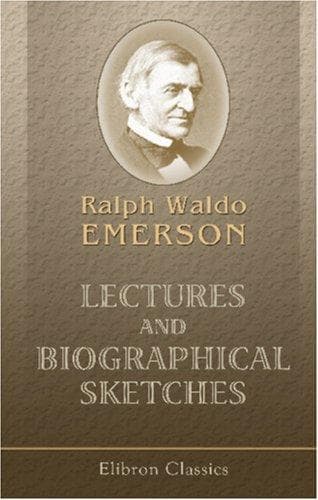
Lectures and biographical sketchesEmerson, Ralph Waldo
Philosophy
Lectures and biographical sketches
Emerson, Ralph Waldo
American essays -- 19th century; Speeches, addresses, etc., American -- 19th century
This perception is a sword such as was never drawn before. It
divides and detaches bone and marrow, soul and body, yea, almost
the man from himself. It is the age of severance, of dissociation,
of freedom, of analysis, of detachment. Every man for himself. The
public speaker disclaims speaking for any other; he answers only for
himself. The social sentiments are weak; the sentiment of patriotism
is weak; veneration is low; the natural affections feebler than they
were. People grow philosophical about native land and parents and
relations. There is an universal resistance to ties and ligaments
once supposed essential to civil society. The new race is stiff, heady
and rebellious; they are fanatics in freedom; they hate tolls, taxes,
turnpikes, banks, hierarchies, governors, yea, almost laws. They have a
neck of unspeakable tenderness; it winces at a hair. They rebel against
theological as against political dogmas; against mediation, or saints,
or any nobility in the unseen.
The age tends to solitude. The association of the time is accidental
and momentary and hypocritical, the detachment intrinsic and
progressive. The association is for power, merely,--for means; the end
being the enlargement and independency of the individual. Anciently,
society was in the course of things. There was a Sacred Band, a Theban
Phalanx. There can be none now. College classes, military corps, or
trades-unions may fancy themselves indissoluble for a moment, over
their wine; but it is a painted hoop, and has no girth. The age of
arithmetic and of criticism has set in. The structures of old faith in
every department of society a few centuries have sufficed to destroy.
Astrology, magic, palmistry, are long gone. The very last ghost is
laid. Demonology is on its last legs. Prerogative, government, goes to
pieces day by day. Europe is strewn with wrecks; a constitution once a
week. In social manners and morals the revolution is just as evident.
In the law courts, crimes of fraud have taken the place of crimes of
force. The stockholder has stepped into the place of the warlike baron.
The nobles shall not any longer, as feudal lords, have power of life
and death over the churls, but now, in another shape, as capitalists,
shall in all love and peace eat them up as before. Nay, government
itself becomes the resort of those whom government was invented to
restrain. “Are there any brigands on the road?” inquired the traveller
in France. “Oh, no, set your heart at rest on that point,” said the
landlord; “what should these fellows keep the highway for, when they
can rob just as effectually, and much more at their ease, in the
bureaus of office?”
Public-domain text, read in full here on John Shaqi.
Reviews
Reviews
No reviews yet
Be the first to share your thoughts on this work.
Elsewhere in the archive
Join the Discussion
Join the discussion
Sign in to leave a comment or review.
Sign InorCreate an account