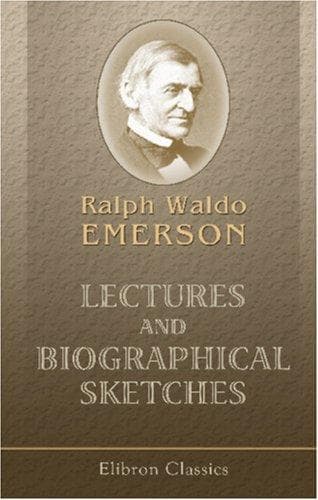
Lectures and biographical sketchesEmerson, Ralph Waldo
Philosophy
Lectures and biographical sketches
Emerson, Ralph Waldo
American essays -- 19th century; Speeches, addresses, etc., American -- 19th century
There was an influence on the young people from the genius of Everett
which was almost comparable to that of Pericles in Athens. He had
an inspiration which did not go beyond his head, but which made him
the master of elegance. If any of my readers were at that period in
Boston or Cambridge, they will easily remember his radiant beauty of
person, of a classic style, his heavy large eye, marble lids, which
gave the impression of mass which the slightness of his form needed;
sculptured lips; a voice of such rich tones, such precise and perfect
utterance, that, although slightly nasal, it was the most mellow and
beautiful and correct of all the instruments of the time. The word
that he spoke, in the manner in which he spoke it, became current and
classical in New England. He had a great talent for collecting facts,
and for bringing those he had to bear with ingenious felicity on the
topic of the moment. Let him rise to speak on what occasion soever, a
fact had always just transpired which composed, with some other fact
well known to the audience, the most pregnant and happy coincidence.
It was remarked that for a man who threw out so many facts he was
seldom convicted of a blunder. He had a good deal of special learning,
and all his learning was available for purposes of the hour. It was
all new learning, that wonderfully took and stimulated the young men.
It was so coldly and weightily communicated from so commanding a
platform, as if in the consciousness and consideration of all history
and all learning,--adorned with so many simple and austere beauties
of expression, and enriched with so many excellent digressions and
significant quotations, that, though nothing could be conceived
beforehand less attractive or indeed less fit for green boys from
Connecticut, New Hampshire and Massachusetts, with their unripe Latin
and Greek reading, than exegetical discourses in the style of Voss and
Wolff and Ruhnken, on the Orphic and Ante-Homeric remains,--yet this
learning instantly took the highest place to our imagination in our
unoccupied American Parnassus. All his auditors felt the extreme beauty
and dignity of the manner, and even the coarsest were contented to go
punctually to listen, for the manner, when they had found out that the
subject-matter was not for them. In the lecture-room, he abstained
from all ornament, and pleased himself with the play of detailing
erudition in a style of perfect simplicity. In the pulpit (for he was
then a clergyman) he made amends to himself and his auditor for the
self-denial of the professor’s chair, and, with an infantine simplicity
still, of manner, he gave the reins to his florid, quaint and affluent
fancy.
Public-domain text, read in full here on John Shaqi.
Reviews
Reviews
No reviews yet
Be the first to share your thoughts on this work.
Elsewhere in the archive
Join the Discussion
Join the discussion
Sign in to leave a comment or review.
Sign InorCreate an account