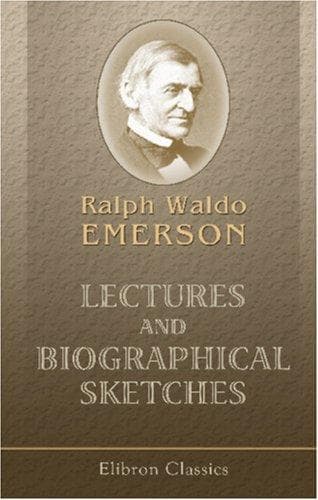
Lectures and biographical sketchesEmerson, Ralph Waldo
Philosophy
Lectures and biographical sketches
Emerson, Ralph Waldo
American essays -- 19th century; Speeches, addresses, etc., American -- 19th century
In literature the effect appeared in the decided tendency of criticism.
The most remarkable literary work of the age has for its hero and
subject precisely this introversion: I mean the poem of Faust. In
philosophy, Immanuel Kant has made the best catalogue of the human
faculties and the best analysis of the mind. Hegel also, especially.
In science the French _savant_, exact, pitiless, with barometer,
crucible, chemic test and calculus in hand, travels into all nooks and
islands, to weigh, to analyze and report. And chemistry, which is the
analysis of matter, has taught us that we eat gas, drink gas, tread on
gas, and are gas. The same decomposition has changed the whole face
of physics; the like in all arts, modes. Authority falls, in Church,
College, Courts of Law, Faculties, Medicine. Experiment is credible;
antiquity is grown ridiculous.
It marked itself by a certain predominance of the intellect in the
balance of powers. The warm swart Earth-spirit which made the strength
of past ages, mightier than it knew, with instincts instead of science,
like a mother yielding food from her own breast instead of preparing it
through chemic and culinary skill,--warm negro ages of sentiment and
vegetation,--all gone; another hour had struck and other forms arose.
Instead of the social existence which all shared, was now separation.
Every one for himself; driven to find all his resources, hopes,
rewards, society and deity within himself.
The young men were born with knives in their brain, a tendency to
introversion, self-dissection, anatomizing of motives. The popular
religion of our fathers had received many severe shocks from the
new times; from the Arminians, which was the current name of the
backsliders from Calvinism, sixty years ago; then from the English
philosophic theologians, Hartley and Priestley and Belsham, the
followers of Locke; and then I should say much later from the slow
but extraordinary influence of Swedenborg; a man of prodigious mind,
though as I think tainted with a certain suspicion of insanity, and
therefore generally disowned, but exerting a singular power over an
important intellectual class; then the powerful influence of the genius
and character of Dr. Channing.
Germany had created criticism in vain for us until 1820, when Edward
Everett returned from his five years in Europe, and brought to
Cambridge his rich results, which no one was so fitted by natural grace
and the splendor of his rhetoric to introduce and recommend. He made
us for the first time acquainted with Wolff’s theory of the Homeric
writings, with the criticism of Heyne. The novelty of the learning
lost nothing in the skill and genius of his relation, and the rudest
undergraduate found a new morning opened to him in the lecture-room of
Harvard Hall.
Public-domain text, read in full here on John Shaqi.
Reviews
Reviews
No reviews yet
Be the first to share your thoughts on this work.
Elsewhere in the archive
Join the Discussion
Join the discussion
Sign in to leave a comment or review.
Sign InorCreate an account