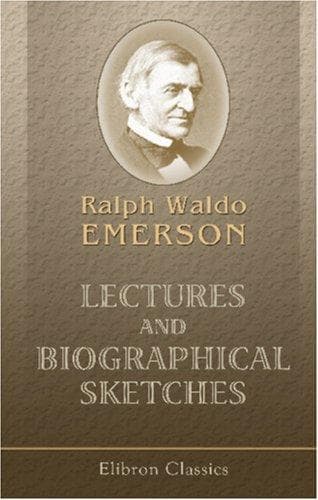
Lectures and biographical sketchesEmerson, Ralph Waldo
Philosophy
Lectures and biographical sketches
Emerson, Ralph Waldo
American essays -- 19th century; Speeches, addresses, etc., American -- 19th century
There is of course to every theory a tendency to run to an extreme,
and to forget the limitations. In our free institutions, where every
man is at liberty to choose his home and his trade, and all possible
modes of working and gaining are open to him, fortunes are easily made
by thousands, as in no other country. Then property proves too much
for the man, and the men of science, art, intellect, are pretty sure
to degenerate into selfish housekeepers, dependent on wine, coffee,
furnace-heat, gas-light and fine furniture. Then instantly things
swing the other way, and we suddenly find that civilization crowed
too soon; that what we bragged as triumphs were treacheries: that we
have opened the wrong door and let the enemy into the castle; that
civilization was a mistake; that nothing is so vulgar as a great
warehouse of rooms full of furniture and trumpery; that, in the
circumstances, the best wisdom were an auction or a fire. Since the
foxes and the birds have the right of it, with a warm hole to keep
out the weather, and no more,--a pent-house to fend the sun and rain
is the house which lays no tax on the owner’s time and thoughts, and
which he can leave, when the sun is warm, and defy the robber. This
was Thoreau’s doctrine, who said that the Fourierists had a sense of
duty which led them to devote themselves to their second-best. And
Thoreau gave in flesh and blood and pertinacious Saxon belief the
purest ethics. He was more real and practically believing in them than
any of his company, and fortified you at all times with an affirmative
experience which refused to be set aside. Thoreau was in his own
person a practical answer, almost a refutation, to the theories of the
socialists. He required no Phalanx, no Government, no society, almost
no memory. He lived extempore from hour to hour, like the birds and
the angels; brought every day a new proposition, as revolutionary as
that of yesterday, but different: the only man of leisure in his town;
and his independence made all others look like slaves. He was a good
Abbot Sampson, and carried a counsel in his breast. “Again and again I
congratulate myself on my so-called poverty, I could not overstate this
advantage.” “What you call bareness and poverty, is to me simplicity.
God could not be unkind to me if he should try. I love best to have
each thing in its season only, and enjoy doing without it at all other
times. It is the greatest of all advantages to enjoy no advantage at
all. I have never got over my surprise that I should have been born
into the most estimable place in all the world, and in the very nick of
time too.” There’s an optimist for you.
Public-domain text, read in full here on John Shaqi.
Reviews
Reviews
No reviews yet
Be the first to share your thoughts on this work.
Elsewhere in the archive
Join the Discussion
Join the discussion
Sign in to leave a comment or review.
Sign InorCreate an account