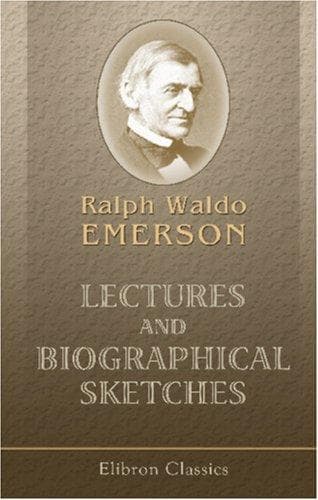
Lectures and biographical sketchesEmerson, Ralph Waldo
Philosophy
Lectures and biographical sketches
Emerson, Ralph Waldo
American essays -- 19th century; Speeches, addresses, etc., American -- 19th century
I regard these philanthropists as themselves the effects of the age
in which we live, and, in common with so many other good facts,
the efflorescence of the period, and predicting a good fruit that
ripens. They were not the creators they believed themselves, but they
were unconscious prophets of a true state of society; one which the
tendencies of nature lead unto, one which always establishes itself
for the sane soul, though not in that manner in which they paint it;
but they were describers of that which is really being done. The large
cities are phalansteries; and the theorists drew all their argument
from facts already taking place in our experience. The cheap way is
to make every man do what he was born for. One merchant to whom I
described the Fourier project, thought it must not only succeed, but
that agricultural association must presently fix the price of bread,
and drive single farmers into association in self-defence, as the great
commercial and manufacturing companion had done. Society in England
and in America is trying the experiment again in small pieces, in
co-operative associations, in cheap eating-houses, as well as in the
economies of club-houses and in cheap reading-rooms.
It chanced that here in one family were two brothers, one a brilliant
and fertile inventor, and close by him his own brother, a man of
business, who knew how to direct his faculty and make it instantly and
permanently lucrative. Why could not the like partnership be formed
between the inventor and the man of executive talent everywhere? Each
man of thought is surrounded by wiser men than he, if they cannot
write as well. Cannot he and they combine? Talents supplement each
other. Beaumont and Fletcher and many French novelists have known how
to utilize such partnerships. Why not have a larger one, and with more
various members?
Housekeepers say, “There are a thousand things to everything,” and
if one must study all the strokes to be laid, all the faults to be
shunned in a building or work of art, of its keeping, its composition,
its site, its color, there would be no end. But the architect, acting
under a necessity to build the house for its purpose, finds himself
helped, he knows not how, into all these merits of detail, and
steering clear, though in the dark, of those dangers which might have
shipwrecked him.
BROOK FARM.
Public-domain text, read in full here on John Shaqi.
Reviews
Reviews
No reviews yet
Be the first to share your thoughts on this work.
Elsewhere in the archive
Join the Discussion
Join the discussion
Sign in to leave a comment or review.
Sign InorCreate an account