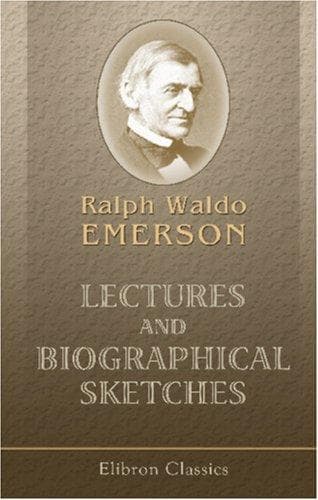
Lectures and biographical sketchesEmerson, Ralph Waldo
Philosophy
Lectures and biographical sketches
Emerson, Ralph Waldo
American essays -- 19th century; Speeches, addresses, etc., American -- 19th century
The Founders of Brook Farm should have this praise, that they made what
all people try to make, an agreeable place to live in. All comers, even
the most fastidious, found it the pleasantest of residences. It is
certain that freedom from household routine, variety of character and
talent, variety of work, variety of means of thought and instruction,
art, music, poetry, reading, masquerade, did not permit sluggishness
or despondency; broke up routine. There is agreement in the testimony
that it was, to most of the associates, education; to many, the most
important period of their life, the birth of valued friendships, their
first acquaintance with the riches of conversation, their training
in behavior. The art of letter-writing, it is said, was immensely
cultivated. Letters were always flying not only from house to house,
but from room to room. It was a perpetual picnic, a French Revolution
in small, an Age of Reason in a patty-pan.
In the American social communities, the gossip found such vent and sway
as to become despotic. The institutions were whispering-galleries,
in which the adored Saxon privacy was lost. Married women I believe
uniformly decided against the community. It was to them like the brassy
and lacquered life in hotels. The common school was well enough, but to
the common nursery they had grave objections. Eggs might be hatched in
ovens, but the hen on her own account much preferred the old way. A hen
without her chickens was but half a hen.
It was a curious experience of the patrons and leaders of this
noted community, in which the agreement with many parties was that
they should give so many hours of instruction in mathematics, in
music, in moral and intellectual philosophy, and so forth,--that in
every instance the new comers showed themselves keenly alive to the
advantages of the society, and were sure to avail themselves of every
means of instruction; their knowledge was increased, their manners
refined,--but they became in that proportion averse to labor, and were
charged by the heads of the departments with a certain indolence and
selfishness.
In practice it is always found that virtue is occasional, spotty,
and not linear or cubic. Good people are as bad as rogues if steady
performance is claimed; the conscience of the conscientious runs in
veins, and the most punctilious in some particulars are latitudinarian
in others. It was very gently said that people on whom beforehand all
persons would put the utmost reliance were not responsible. They saw
the necessity that the work must be done, and did it not, and it of
course fell to be done by the few religious workers. No doubt there was
in many a certain strength drawn from the fury of dissent. Thus Mr.
Ripley told Theodore Parker, “There is your accomplished friend ----,
he would hoe corn all Sunday if I would let him, but all Massachusetts
could not make him do it on Monday.”
Public-domain text, read in full here on John Shaqi.
Reviews
Reviews
No reviews yet
Be the first to share your thoughts on this work.
Elsewhere in the archive
Join the Discussion
Join the discussion
Sign in to leave a comment or review.
Sign InorCreate an account