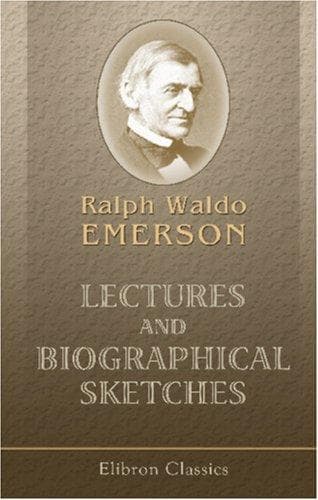
Lectures and biographical sketchesEmerson, Ralph Waldo
Philosophy
Lectures and biographical sketches
Emerson, Ralph Waldo
American essays -- 19th century; Speeches, addresses, etc., American -- 19th century
I have found that I could only bring you this portrait by selections
from the diary of my heroine, premising a sketch of her time and
place. I report some of the thoughts and soliloquies of a country girl,
poor, solitary,--‘a goody’ as she called herself,--growing from youth
to age amid slender opportunities and usually very humble company.
Mary Moody Emerson was born just before the outbreak of the Revolution.
When introduced to Lafayette at Portland, she told him that she was
“in arms” at the Concord Fight. Her father, the minister of Concord,
a warm patriot in 1775, went as a chaplain to the American army at
Ticonderoga: he carried his infant daughter, before he went, to his
mother in Malden and told her to keep the child until he returned.
He died at Rutland, Vermont, of army-fever, the next year, and Mary
remained at Malden with her grandmother, and, after her death, with her
father’s sister, in whose house she grew up, rarely seeing her brothers
and sisters in Concord. This aunt and her husband lived on a farm, were
getting old, and the husband a shiftless, easy man. There was plenty of
work for the little niece to do day by day, and not always bread enough
in the house.
One of her tasks, it appears, was to watch for the approach of the
deputy-sheriff, who might come to confiscate the spoons or arrest the
uncle for debt. Later, another aunt, who had become insane, was brought
hither to end her days. More and sadder work for this young girl. She
had no companions, lived in entire solitude with these old people,
very rarely cheered by short visits from her brothers and sisters.
Her mother had married again,--married the minister who succeeded her
husband in the parish at Concord, [Dr. Ezra Ripley,] and had now a
young family growing up around her.
Her aunt became strongly attached to Mary, and persuaded the family to
give the child up to her as a daughter, on some terms embracing a care
of her future interests. She would leave the farm to her by will. This
promise was kept; she came into possession of the property many years
after, and her dealings with it gave her no small trouble, though they
give much piquancy to her letters in after years. Finally it was sold,
and its price invested in a share of a farm in Maine, where she lived
as a boarder with her sister, for many years. It was in a picturesque
country, within sight of the White Mountains, with a little lake in
front at the foot of a high hill called Bear Mountain. Not far from
the house was a brook running over a granite floor like the Franconia
Flume, and noble forests around. Every word she writes about this farm
(“Elm Vale,” Waterford,) her dealings and vexations about it, her joys
and raptures of religion and Nature, interest like a romance, and to
those who may hereafter read her letters, will make its obscure acres
amiable.
Public-domain text, read in full here on John Shaqi.
Reviews
Reviews
No reviews yet
Be the first to share your thoughts on this work.
Elsewhere in the archive
Join the Discussion
Join the discussion
Sign in to leave a comment or review.
Sign InorCreate an account