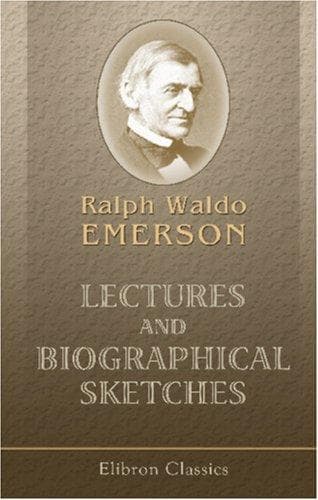
Lectures and biographical sketchesEmerson, Ralph Waldo
Philosophy
Lectures and biographical sketches
Emerson, Ralph Waldo
American essays -- 19th century; Speeches, addresses, etc., American -- 19th century
In Malden she lived through all her youth and early womanhood, with
the habit of visiting the families of her brothers and sisters on any
necessity of theirs. Her good will to serve in time of sickness or of
pressure was known to them, and promptly claimed, and her attachment
to the youths and maidens growing up in those families was secure for
any trait of talent or of character. Her sympathy for young people who
pleased her was almost passionate, and was sure to make her arrival in
each house a holiday.
Her early reading was Milton, Young, Akenside, Samuel Clarke, Jonathan
Edwards, and always the Bible. Later, Plato, Plotinus, Marcus
Antoninus, Stewart, Coleridge, Cousin, Herder, Locke, Madame De Staël,
Channing, Mackintosh, Byron. Nobody can read in her manuscript, or
recall the conversation of old-school people, without seeing that
Milton and Young had a religious authority in their mind, and nowise
the slight, merely entertaining quality of modern bards. And Plato,
Aristotle, Plotinus, how venerable and organic as Nature they are in
her mind! What a subject is her mind and life for the finest novel!
When I read Dante, the other day, and his paraphrases to signify
with more adequateness Christ or Jehovah, whom do you think I was
reminded of? Whom but Mary Emerson and her eloquent theology? She
had a deep sympathy with genius. When it was unhallowed, as in Byron,
she had none the less, whilst she deplored and affected to denounce
him. But she adored it when ennobled by character. She liked to
notice that the greatest geniuses have died ignorant of their power
and influence. She wished you to scorn to shine. “My opinion,” she
writes, (is) “that a mind like Byron’s would never be satisfied with
modern Unitarianism,--that the fiery depths of Calvinism, its high
and mysterious elections to eternal bliss, beyond angels, and all its
attendant wonders would have alone been fitted to fix his imagination.”
Her wit was so fertile, and only used to strike, that she never used
it for display, any more than a wasp would parade his sting. It was
ever the will and not the phrase that concerned her. Yet certain
expressions, when they marked a memorable state of mind in her
experience, recurred to her afterwards, and she would vindicate herself
as having said to Dr. R---- or Uncle L---- so and so, at such a period
of her life. But they were intensely true when first spoken. All her
language was happy, but inimitable, unattainable by talent, as if
caught from some dream. She calls herself “the puny pilgrim, whose sole
talent is sympathy.” “I like that kind of apathy that is a triumph to
overset.”
Public-domain text, read in full here on John Shaqi.
Reviews
Reviews
No reviews yet
Be the first to share your thoughts on this work.
Elsewhere in the archive
Join the Discussion
Join the discussion
Sign in to leave a comment or review.
Sign InorCreate an account