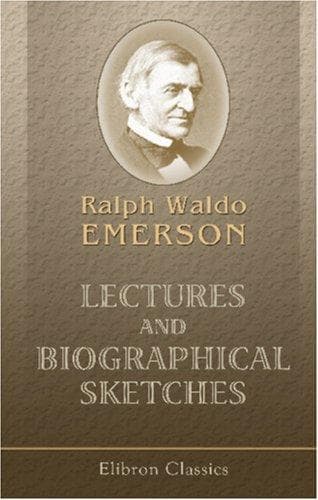
Lectures and biographical sketchesEmerson, Ralph Waldo
Philosophy
Lectures and biographical sketches
Emerson, Ralph Waldo
American essays -- 19th century; Speeches, addresses, etc., American -- 19th century
“Jan. 21. Weary at times of objects so tedious to hear and see. O the
power of vision, then the delicate power of the nerve which receives
impressions from sounds! If ever I am blest with a social life, let the
accent be grateful. Could I at times be regaled with music, it would
remind me that there are _sounds_. Shut up in this severe weather
with careful, infirm, afflicted age, it is wonderful, my spirits: hopes
I can have none. Not a prospect but is dark on earth, as to knowledge
and joy from externals: but the prospect of a dying bed reflects lustre
on all the rest.
“The evening is fine, but I dare not enjoy it. The moon and stars
reproach me, because I had to do with mean fools. Should I take so
much care to save a few dollars? Never was I so much ashamed. Did
I say with what rapture I might dispose of them to the poor? Pho!
self-preservation, dignity, confidence in the future, contempt of
trifles! Alas, I am disgraced. Took a momentary revenge on ---- for
worrying me.”
“Jan. 30. I walked to Captain Dexter’s. Sick. Promised never to put
that ring on. Ended miserably the month which began so worldly.
“It was the choice of the Eternal that gave the glowing seraph his
joys, and to me my vile imprisonment. I adore Him. It was His will
that gives my superiors to shine in wisdom, friendship, and ardent
pursuits, while I pass my youth, its last traces, in the veriest shades
of ignorance and complete destitution of society. I praise Him, though
when my strength of body falters, it is a trial not easily described.”
“True, I must finger the very farthing candle-ends,--the duty assigned
to my pride; and indeed so poor are some of those allotted to join me
on the weary needy path, that ’tis benevolence enjoins self-denial.
Could I but dare it in the bread-and-water diet! Could I but live free
from calculation, as in the first half of life, when my poor aunt
lived. I had ten dollars a year for clothes and charity, and I never
remember to have been needy, though I never had but two or three aids
in those six years of earning my home. That ten dollars my dear father
earned, and one hundred dollars remain, and I can’t bear to take it,
and don’t know what to do. Yet I would not breathe to ---- or ---- my
want. ’Tis only now that I would not let ---- pay my hotel-bill. They
have enough to do. Besides, it would send me packing to depend for
anything. Better anything than dishonest dependence, which robs the
poorer, and despoils friendship of equal connection.”
In 1830, in one of her distant homes, she reproaches herself with some
sudden passion she has for visiting her old home and friends in the
city, where she had lived for a while with her brother [Mr. Emerson’s
father] and afterwards with his widow. “Do I yearn to be in Boston?
’Twould fatigue, disappoint; I, who have so long despised means, who
have always found it a sort of rebellion to seek them? Yet the old
desire for the worm is not so greedy as [mine] to find myself in my old
haunts.”
Public-domain text, read in full here on John Shaqi.
Reviews
Reviews
No reviews yet
Be the first to share your thoughts on this work.
Elsewhere in the archive
Join the Discussion
Join the discussion
Sign in to leave a comment or review.
Sign InorCreate an account