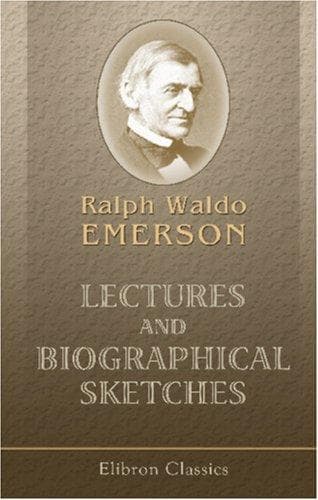
Lectures and biographical sketchesEmerson, Ralph Waldo
Philosophy
Lectures and biographical sketches
Emerson, Ralph Waldo
American essays -- 19th century; Speeches, addresses, etc., American -- 19th century
HERE is a day on which more public good or evil is to be done than
was ever done on any day. And this is the pregnant season, when our
old Roman, Samuel Hoar, has chosen to quit this world. _Ab iniquo
certamine indignabundus recessit._
He was born under a Christian and humane star, full of mansuetude and
nobleness, honor and charity; and, whilst he was willing to face every
disagreeable duty, whilst he dared to do all that might beseem a man,
his self-respect restrained him from any foolhardiness. The Homeric
heroes, when they saw the gods mingling in the fray, sheathed their
swords. So did not he feel any call to make it a contest of personal
strength with mobs or nations; but when he saw the day and the gods
went against him, he withdrew, but with an unaltered belief. All was
conquered _præter atrocem animum Catonis_.
At the time when he went to South Carolina as the Commissioner of
Massachusetts, in 1844, whilst staying in Charleston, pending his
correspondence with the governor and the legal officers, he was
repeatedly warned that it was not safe for him to appear in public,
or to take his daily walk, as he had done, unattended by his friends,
in the streets of the city. He was advised to withdraw to private
lodgings, which were eagerly offered him by friends. He rejected the
advice, and refused the offers, saying that he was old, and his life
was not worth much, but he had rather the boys should troll his old
head like a foot-ball in their streets, than that he should hide it.
And he continued the uniform practice of his daily walk into all parts
of the city. But when the mob of Charleston was assembled in the
streets before his hotel, and a deputation of gentlemen waited upon him
in the hall to say they had come with the unanimous voice of the state
to remove him by force, and the carriage was at the door, he considered
his duty discharged to the last point of possibility. The force was
apparent and irresistible; the legal officer’s part was up; it was
now time for the military officer to be sent; and he said, “Well,
gentlemen, since it is your pleasure to use force, I must go.” But his
opinion was unchanged.
In like manner now, when the votes of the Free States, as shown in the
recent election in the State of Pennsylvania, had disappointed the
hopes of mankind and betrayed the cause of freedom, he considered the
question of justice and liberty, for his age, lost, and had no longer
the will to drag his days through the dishonors of the long defeat, and
promptly withdrew, but with unaltered belief.
Public-domain text, read in full here on John Shaqi.
Reviews
Reviews
No reviews yet
Be the first to share your thoughts on this work.
Elsewhere in the archive
Join the Discussion
Join the discussion
Sign in to leave a comment or review.
Sign InorCreate an account