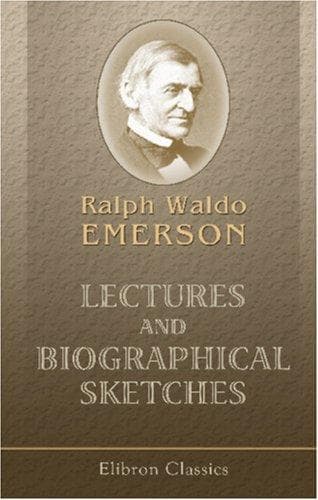
Lectures and biographical sketchesEmerson, Ralph Waldo
Philosophy
Lectures and biographical sketches
Emerson, Ralph Waldo
American essays -- 19th century; Speeches, addresses, etc., American -- 19th century
He loved the dogmas and the simple usages of his church; was
always an honored and sometimes an active member. He never shrunk
from a disagreeable duty. In the time of the Sunday laws he was a
tithing-man; under the Maine Law he was a prosecutor of the liquor
dealers. It seemed as if the New England church had formed him to be
its friend and defender; the lover and assured friend of its parish
by-laws, of its ministers, its rites, and its social reforms. He was a
model of those formal but reverend manners which make what is called
a gentleman of the old school, so called under an impression that the
style is passing away, but which, I suppose, is an optical illusion,
as there are always a few more of the class remaining, and always a
few young men to whom these manners are native.
I have spoken of his modesty; he had nothing to say about himself;
and his sincere admiration was commanded by certain heroes of the
profession, like Judge Parsons and Judge Marshall, Mr. Mason and Mr.
Webster. When some one said, in his presence, that Chief Justice
Marshall was failing in his intellect, Mr. Hoar remarked that “Judge
Marshall could afford to lose brains enough to furnish three or four
common men, before common men would find it out.” He had a huge
respect for Mr. Webster’s ability, with whom he had often occasion to
try his strength at the bar, and a proportionately deep regret at Mr.
Webster’s political course in his later years.
There was no elegance in his reading or tastes beyond the crystal
clearness of his mind. He had no love of poetry; and I have heard that
the only verse that he was ever known to quote was the Indian rule:
“When the oaks are in the gray,
Then, farmers, plant away.”
But I find an elegance in his quiet but firm withdrawal from all
business in the courts which he could drop without manifest detriment
to the interests involved (and this when in his best strength), and
his self-dedication thenceforward to unpaid services of the Temperance
and Peace and other philanthropic societies, the Sunday Schools, the
cause of Education, and specially of the University, and to such
political activities as a strong sense of duty and the love of order
and of freedom urged him to forward.
Perfect in his private life, the husband, father, friend, he was
severe only with himself. He was as if on terms of honor with those
nearest him, nor did he think a lifelong familiarity could excuse any
omission of courtesy from him. He carried ceremony finely to the last.
But his heart was all gentleness, gratitude and bounty.
With beams December planets dart,
His cold eye truth and conduct scanned;
July was in his sunny heart,
October in his liberal hand.
THOREAU.
Public-domain text, read in full here on John Shaqi.
Reviews
Reviews
No reviews yet
Be the first to share your thoughts on this work.
Elsewhere in the archive
Join the Discussion
Join the discussion
Sign in to leave a comment or review.
Sign InorCreate an account