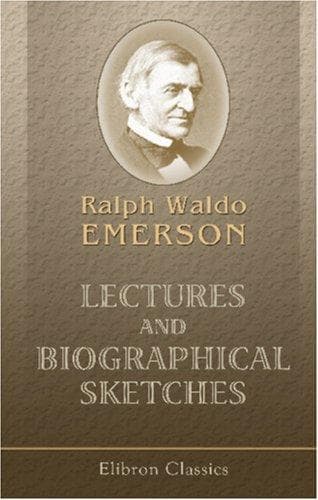
Lectures and biographical sketchesEmerson, Ralph Waldo
Philosophy
Lectures and biographical sketches
Emerson, Ralph Waldo
American essays -- 19th century; Speeches, addresses, etc., American -- 19th century
These tactics of the lawyer were the tactics of his life. He had
uniformly the air of knowing just what he wanted and of going to that
in the shortest way. It is singular that his character should make
so deep an impression, standing and working as he did on so common
a ground. He was neither spiritualist nor man of genius nor of a
literary nor an executive talent. In strictness the vigor of his
understanding was directed on the ordinary domestic and municipal
well-being. Society had reason to cherish him, for he was a main
pillar on which it leaned. The useful and practical super-abounded
in his mind, and to a degree which might be even comic to young and
poetical persons. If he spoke of the engagement of two lovers, he
called it a contract. Nobody cared to speak of thoughts or aspirations
to a black-letter lawyer, who only studied to keep men out of prison,
and their lands out of attachment. Had you read Swedenborg or Plotinus
to him, he would have waited till you had done, and answered you out
of the Revised Statutes. He had an affinity for mathematics, but it
was a taste rather than a pursuit, and of the modern sciences he liked
to read popular books on geology. Yet so entirely was this respect to
the ground plan and substructure of society a natural ability, and
from the order of his mind, and not for “tickling commodity,” that
it was admirable, as every work of nature is, and like one of those
opaque crystals, big beryls weighing tons, which are found in Acworth,
New Hampshire, not less perfect in their angles and structure, and
only less beautiful, than the transparent topazes and diamonds.
Meantime, whilst his talent and his profession led him to guard the
material wealth of society, a more disinterested person did not exist.
And if there were regions of knowledge not open to him, he did not
pretend to them. His modesty was sincere. He had a childlike innocence
and a native temperance, which left him no temptations, and enabled
him to meet every comer with a free and disengaged courtesy that had
no memory in it
“Of wrong and outrage with which earth is filled.”
No person was more keenly alive to the stabs which the ambition and
avarice of men inflicted on the commonwealth. Yet when politicians
or speculators approached him, these memories left no scar; his
countenance had an unalterable tranquillity and sweetness; he had
nothing to repent of,--let the cloud rest where it might, he dwelt in
eternal sunshine.
He had his birth and breeding in a little country town, where the
old religion existed in strictness, and spent all his energy in
creating purity of manners and careful education. No art or practice
of the farm was unknown to him, and the farmers greeted him as one of
themselves, whilst they paid due homage to his powers of mind and to
his virtues.
Public-domain text, read in full here on John Shaqi.
Reviews
Reviews
No reviews yet
Be the first to share your thoughts on this work.
Elsewhere in the archive
Join the Discussion
Join the discussion
Sign in to leave a comment or review.
Sign InorCreate an account