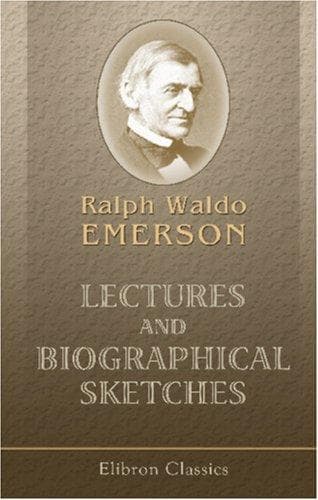
Lectures and biographical sketchesEmerson, Ralph Waldo
Philosophy
Lectures and biographical sketches
Emerson, Ralph Waldo
American essays -- 19th century; Speeches, addresses, etc., American -- 19th century
He is not mainly a scholar, like the most of my acquaintances, but
a practical Scotchman, such as you would find in any saddler’s or
iron-dealer’s shop, and then only accidentally and by a surprising
addition, the admirable scholar and writer he is. If you would know
precisely how he talks, just suppose Hugh Whelan (the gardener) had
found leisure enough in addition to all his daily work to read Plato
and Shakspeare, Augustine and Calvin, and, remaining Hugh Whelan all
the time, should talk scornfully of all this nonsense of books that
he had been bothered with, and you shall have just the tone and talk
and laughter of Carlyle. I called him a trip-hammer with “an Æolian
attachment.” He has, too, the strong religious tinge you sometimes
find in burly people. That, and all his qualities, have a certain
virulence, coupled though it be in his case with the utmost impatience
of Christendom and Jewdom and all existing presentments of the good
old story. He talks like a very unhappy man,--profoundly solitary,
displeased and hindered by all men and things about him, and, biding
his time, meditating how to undermine and explode the whole world of
nonsense which torments him. He is obviously greatly respected by all
sorts of people, understands his own value quite as well as Webster, of
whom his behavior sometimes reminds me, and can see society on his own
terms.
And, though no mortal in America could pretend to talk with Carlyle,
who is also as remarkable in England as the Tower of London, yet
neither would he in any manner satisfy us (Americans), or begin to
answer the questions which we ask. He is a very national figure, and
would by no means bear transplantation. They keep Carlyle as a sort of
portable cathedral-bell, which they like to produce in companies where
he is unknown, and set a-swinging, to the surprise and consternation
of all persons,--bishops, courtiers, scholars, writers,--and, as in
companies here (in England) no man is named or introduced, great is
the effect and great the inquiry. Forster of Rawdon described to me
a dinner at the _table d’hôte_ of some provincial hotel where
he carried Carlyle, and where an Irish canon had uttered something.
Carlyle began to talk, first to the waiters, and then to the walls, and
then, lastly, unmistakably to the priest, in a manner that frightened
the whole company.
Public-domain text, read in full here on John Shaqi.
Reviews
Reviews
No reviews yet
Be the first to share your thoughts on this work.
Elsewhere in the archive
Join the Discussion
Join the discussion
Sign in to leave a comment or review.
Sign InorCreate an account