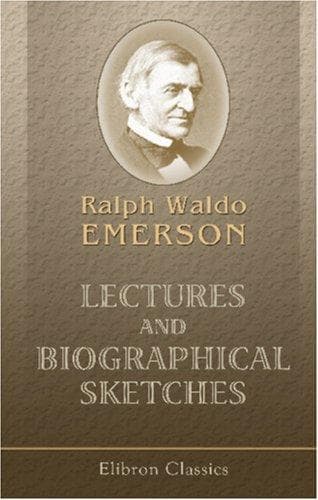
Lectures and biographical sketchesEmerson, Ralph Waldo
Philosophy
Lectures and biographical sketches
Emerson, Ralph Waldo
American essays -- 19th century; Speeches, addresses, etc., American -- 19th century
Young men, especially those holding liberal opinions, press to see
him, but it strikes me like being hot to see the mathematical or
Greek professor before they have got their lesson. It needs something
more than a clean shirt and reading German to visit him. He treats
them with contempt; they profess freedom and he stands for slavery;
they praise republics and he likes the Russian Czar; they admire
Cobden and free trade and he is a protectionist in political economy;
they will eat vegetables and drink water, and he is a Scotchman who
thinks English national character has a pure enthusiasm for beef
and mutton,--describes with gusto the crowds of people who gaze at
the sirloins in the dealer’s shop-window, and even likes the Scotch
night-cap; they praise moral suasion, he goes for murder, money,
capital punishment, and other pretty abominations of English law. They
wish freedom of the press, and he thinks the first thing he would do,
if he got into Parliament, would be to turn out the reporters, and stop
all manner of mischievous speaking to Buncombe, and wind-bags. “In the
Long Parliament,” he says, “the only great Parliament, they sat secret
and silent, grave as an ecumenical council, and I know not what they
would have done to anybody that had got in there and attempted to tell
out of doors what they did.” They go for free institutions, for letting
things alone, and only giving opportunity and motive to every man;
he for a stringent government, that shows people what they must do,
and makes them do it. “Here,” he says, “the Parliament gathers up six
millions of pounds every year to give to the poor, and yet the people
starve. I think if they would give it to me, to provide the poor with
labor, and with authority to make them work or shoot them,--and I to be
hanged if I did not do it,--I could find them in plenty of Indian meal.”
He throws himself readily on the other side. If you urge free trade, he
remembers that every laborer is a monopolist. The navigation laws of
England made its commerce. “St. John was insulted by the Dutch; he came
home, got the law passed that foreign vessels should pay high fees, and
it cut the throat of the Dutch, and made the English trade.” If you
boast of the growth of the country, and show him the wonderful results
of the census, he finds nothing so depressing as the sight of a great
mob. He saw once, as he told me, three or four miles of human beings,
and fancied that “the airth was some great cheese, and these were
mites.” If a tory takes heart at his hatred of stump-oratory and model
republics, he replies, “Yes, the idea of a pig-headed soldier who will
obey orders, and fire on his own father at the command of his officer,
is a great comfort to the aristocratic mind.” It is not so much that
Carlyle cares for this or that dogma, as that he likes genuineness (the
source of all strength) in his companions.
Public-domain text, read in full here on John Shaqi.
Reviews
Reviews
No reviews yet
Be the first to share your thoughts on this work.
Elsewhere in the archive
Join the Discussion
Join the discussion
Sign in to leave a comment or review.
Sign InorCreate an account