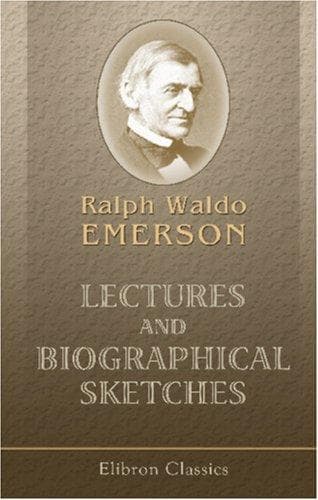
Lectures and biographical sketchesEmerson, Ralph Waldo
Philosophy
Lectures and biographical sketches
Emerson, Ralph Waldo
American essays -- 19th century; Speeches, addresses, etc., American -- 19th century
If a scholar goes into a camp of lumbermen or a gang of riggers,
those men will quickly detect any fault of character. Nothing will
pass with them but what is real and sound. So this man is a hammer
that crushes mediocrity and retention. He detects weakness on the
instant, and touches it. He has a vivacious, aggressive temperament,
and unimpressionable. The literary, the fashionable, the political man,
each fresh from triumphs in his own sphere, comes eagerly to see this
man, whose fun they have heartily enjoyed, sure of a welcome, and are
struck with despair at the first onset. His firm, victorious, scoffing
vituperation strikes them with chill and hesitation. His talk often
reminds you of what was said of Johnson: “If his pistol missed fire he
would knock you down with the butt-end.”
Mere intellectual partisanship wearies him; he detects in an instant
if a man stands for any cause to which he is not born and organically
committed. A natural defender of anything, a lover who will live and
die for that which he speaks for, and who does not care for him or for
anything but his own business, he respects; and the nobler this object,
of course, the better. He hates a literary trifler, and if, after
Guizot had been a tool of Louis Philippe for years, he is now to come
and write essays on the character of Washington, on “The Beautiful,”
and on “Philosophy of History,” he thinks that nothing.
Great is his reverence for realities,--for all such traits as spring
from the intrinsic nature of the actor. He humors this into the
idolatry of strength. A strong nature has a charm for him, previous,
it would seem, to all inquiry whether the force be divine or diabolic.
He preaches, as by cannonade, the doctrine that every noble nature
was made by God, and contains, if savage passions, also fit checks
and grand impulses, and, however extravagant, will keep its orbit and
return from far.
Nor can that decorum which is the idol of the Englishman, and in
attaining which the Englishman exceeds all nations, win from him any
obeisance. He is eaten up with indignation against such as desire to
make a fair show in the flesh.
Combined with this warfare on respectabilities, and, indeed, pointing
all his satire, is the severity of his moral sentiment. In proportion
to the peals of laughter amid which he strips the plumes of a pretender
and shows the lean hypocrisy to every vantage of ridicule, does he
worship whatever enthusiasm, fortitude, love, or other sign of a good
nature is in a man.
There is nothing deeper in his constitution than his humor, than the
considerate, condescending good-nature with which he looks at every
object in existence, as a man might look at a mouse. He feels that the
perfection of health is sportiveness, and will not look grave even at
dullness or tragedy.
Public-domain text, read in full here on John Shaqi.
Reviews
Reviews
No reviews yet
Be the first to share your thoughts on this work.
Elsewhere in the archive
Join the Discussion
Join the discussion
Sign in to leave a comment or review.
Sign InorCreate an account