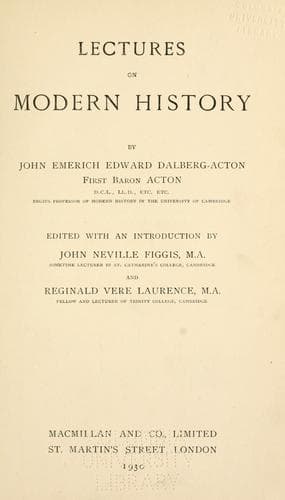
Lectures on Modern historyActon, John Emerich Edward Dalberg Acton, Baron
History
Lectures on Modern history
Acton, John Emerich Edward Dalberg Acton, Baron
History, Modern
NEXT TO the discovery of the New World, the recovery of the ancient
world is the second landmark that divides us from the Middle Ages and
marks the transition to modern life. The Renaissance signifies the
renewed study of Greek, and the consequences that ensued from it,
during the century and a half between Petrarca and Erasmus. It had
survived, as a living language, among Venetian colonists and
Calabrian monks, but exercised no influence on literature.
The movement was preceded by a Roman revival, which originated with
Rienzi. Rome had been abandoned by the Papacy, which had moved from
the Tiber to the Rhone, where it was governed by Frenchmen from
Cahors, and had fallen, like any servile country, into feudal hands.
Rienzi restored the Republic, revived the self-government of the city,
the memories attached to the Capitol, the inscriptions, the monuments
of the men who had ruled the world. The people, no longer great
through the Church, fell back on the greatness which they inherited
from ancient times. The spell by which the Tribune directed their
palm was archaeology. In front of the Capitoline temple, near the
Tapeian rock and the She Wolf's cave, he proclaimed their rights
over the empire and the nations; and he invited the people of Italy
to a national parliament for the restoration of Italian unity and of
the ancient glory and power of Rome. Patriotism, national
independence, popular liberty, all were founded on antiquarian studies
and the rhetorical interpretation of the fragments of the Lex Regia.
Thee political scheme of Rienzi failed, but it started a movement in
the world of thought deeper and more enduring than State transactions.
For his ideas were adopted by the greatest writer then living, and
were expounded by him in the most eloquent and gracious prose that had
been heard for a thousand years. Petrarca called the appearance of
the patriotic tribune and rhetorician the dawn of a new world and a
golden age. Like him, he desired to purge the soil of Italy from the
barbaric taint. It became the constant theme of the Humanists to
protest against the foreign intruder, that is, against the feudal
noble the essential type of the medieval policy. It is the link
between Rienzi, the dreamer of dreams, and the followers of Petrarca.
Bocaccio had already spoken of the acceptable blood of tyrants.
Public-domain text, read in full here on John Shaqi.
Reviews
Reviews
No reviews yet
Be the first to share your thoughts on this work.
Elsewhere in the archive
Join the Discussion
Join the discussion
Sign in to leave a comment or review.
Sign InorCreate an account