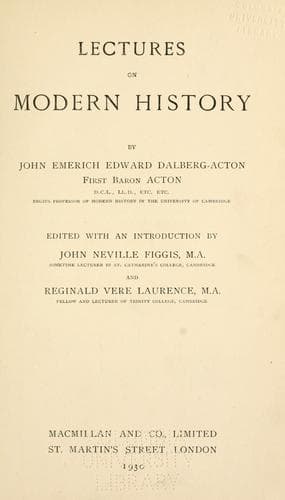
Lectures on Modern historyActon, John Emerich Edward Dalberg Acton, Baron
History
Lectures on Modern history
Acton, John Emerich Edward Dalberg Acton, Baron
History, Modern
But the political influence of antiquity, visible at first, made way
for a purely literary influence. The desire for good Latin became
injurious to Italian, and Petrarca censured Dante for his error in
composing the Divine Comedy in the vulgar tongue. He even regretted
that the Decamerone was not written in Latin, and refused to read what
his friend had written for the level of uneducated men. The classics
became, in the first place, the model and the measure of style; and
the root of the Renaissance was the persuasion that a man who could
write like Cicero had an important advantage over a man who wrote like
Bartolus or William of Ockham; and that ideas radiant with beauty must
conquer ideas clouded over with dialectics. In this, there was an
immediate success. Petrarca and his imitators learnt to write
excellent Latin. Few of them had merit as original thinkers, and what
they did for erudition was done all over again, and incomparably
better, by the scholars who appeared after the tempest of the
Reformation had gone down. But they were excellent letter writers.
In hundreds of volumes, from Petrarca to Sadolet and Pole, we can
trace every idea and mark every throb. It was the first time that the
characters of men were exposed with analytic distinctness; the first
time indeed that character could be examined with accuracy and
certitude.
A new type of men began with Petrarca, men accustomed to
introspection, who selected their own ideals, and moulded their minds
to them. The medieval system could prepare him for death; but, seeing
the vicissitudes of fortune and the difficulties of life, he depended
on the intellectual treasures of the ancient world, on the whole mass
of accessible wisdom, to develop him all round. To men ignorant
of Greek, like the first generation of the Renaissance, the
fourteenth-century men, much in ancient philosophy was obscure. But
one system, that of the Stoics, they studied deeply, and understood,
for they had the works of Seneca. For men craving for self-help and
the complete training of the faculties, eager to escape from the fixed
types of medieval manhood, minted by authority, and taught to distrust
conscience, when it was their own, and to trust it only in others,
Seneca was an oracle. For he is the classic of mental discipline,
vigilant self-study, and the examination of conscience. It is under
these influences that the modern type of individual man took shape.
The action of religion, by reason of the divided Church, and the
hierarchy in partibus, was at a low point; and no age has been so
corrupt, so barbarous in the midst of culture. The finished
individual of the Renaissance, ready for emergencies equal to either
fortune, relying on nothing inherited, but on his own energy and
resource, began badly, little recking rights of others, little caring
for the sanctity of life.
Public-domain text, read in full here on John Shaqi.
Reviews
Reviews
No reviews yet
Be the first to share your thoughts on this work.
Elsewhere in the archive
Join the Discussion
Join the discussion
Sign in to leave a comment or review.
Sign InorCreate an account