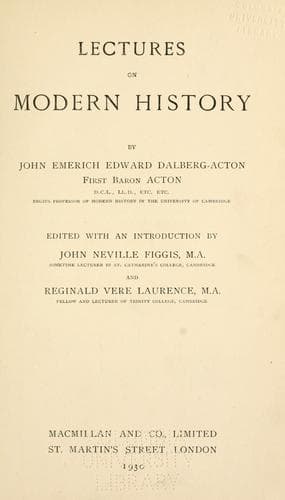
Lectures on Modern historyActon, John Emerich Edward Dalberg Acton, Baron
History
Lectures on Modern history
Acton, John Emerich Edward Dalberg Acton, Baron
History, Modern
There were branches of classical philology in which the Renaissance
was backward. The general purpose was to set up Plato in the place of
Aristotle, discredited as as accomplice of the obscurest schoolmen.
Under the Medici, a Platonic academy flourished at Florence, with
Ficino and Politian at its head. But there was a tendency to merge
Plato in Neoplatonism, and to bridge over what separated him from
Christianity. Neither the knowledge of Plato, nor the knowledge of
the Gospel, profited by the endeavour. The only branch of literature
in which the Renaissance gave birth to real classics, equal to the
ancients, was politics. The medieval theory of politics restrained
the State in the interest of the moral law of the Church, and of the
individual. Laws are made for the public good, and, for the public
good, they may be suspended. The public good is not to be considered,
if it is purchased at the expense of an individual. Authorities are
legitimate if they govern well. Whether they do govern well those
whom they govern must decide. The unwritten laws reigns supreme over
the municipal law. Modern sentiments such as these could not be
sustained in the presence of indifference to religion, uncertainty as
to another world, impatience of the past, and familiarity with
Hellenistic thought. As the Church declined the ancient State
appeared, a State which knew no Church, and was the greatest force on
earth, bound by no code, a law to itself. As there is no such thing
as right, politics are an affair of might, a mere struggle for power.
Such was the doctrine which Venice practised, in the interest of a
glorious and beneficent government, and which two illustrious writers,
Machiavelli and Guicciardini, made the law of modern societies.
Public-domain text, read in full here on John Shaqi.
Reviews
Reviews
No reviews yet
Be the first to share your thoughts on this work.
Elsewhere in the archive
Join the Discussion
Join the discussion
Sign in to leave a comment or review.
Sign InorCreate an account