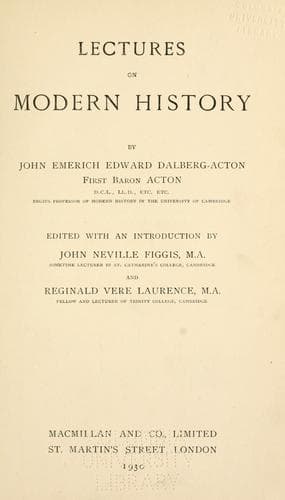
Lectures on Modern historyActon, John Emerich Edward Dalberg Acton, Baron
History
Lectures on Modern history
Acton, John Emerich Edward Dalberg Acton, Baron
History, Modern
The alliance between renovated Hellenism and the Papacy was ratified a
few years later, when the most intelligent of the Italian Humanists,
Aeneas Sylvius Piccolomini of Siena, was raised to the throne under
the name of Pius II, and became the most modern of medieval Popes. He
was one of those Churchmen in whom the classical spirit of the time
predominated over the ecclesiastical. Twice there was a breach, and a
momentary reaction; but on the whole the contract was observed, and
the ancient pagans made their way under the shadow of St. Peter's
better than the early Christians. Humanists of the type of Valla were
domesticated by the prizes held out to them, from the pen of the
secretary to the tiara of the pontiff. The apprehended explosion
never came; the good and evil that was in the new scholars penetrated
the court and modified its tone. Bibbiena's comedies were applauded
at the Belvedere; The Prince was published by the Pope's printer, with
the Pope's permission; a cardinal shrank from reading St. Paul, for
fear of spoiling his style; and the scandals in the family of Borgia
did not prevent bishops from calling him a god. Calixtus III said
that he feared nothing from any hostile Powers, for he had 3000 men of
letters to rely on. His successor, Aeneas Sylvius, considered that
the decline of the empire was due to the fact that scholarship had
gone over to the Papacy. The main fact in the Italian Renaissance is
that an open conflict was averted at the cost of admitting into the
hierarchy something of the profane spirit of the new men, who were
innovators but not reformers. Ficino declares that there was no place
where liberty prevailed as it did at Rome. Poggio, the mocking
adversary of the clergy, was for half a century in the service of the
Popes. Filelfo was handsomely rewarded by Nicholas for satires which
would now be considered scarcely fit for publication. Aeneas Sylvius
laughed at the Donation of Constantine, and wrote an account of his
own Conclave in the tone of a fin de siecle journalist. He is indeed
the founder of freedom of speech in History. When his History of his
own time was published, a great number of passages injurious to his
countrymen and to his ecclesiastical brethren had to be suppressed.
They have been printed lately, and contain, in fifty pages, the
concentrated essence of the wickedness of Italy. Platina wrote an
angry and vindictive History of the Popes, and presented it to Sixtus
IV, who made him librarian of the Vatican. Erasmus, who had a sort of
clerical bias, warmly extols the light and liberty which he found at
Rome in 1515, at the very eve of the Reformation.
Public-domain text, read in full here on John Shaqi.
Reviews
Reviews
No reviews yet
Be the first to share your thoughts on this work.
Elsewhere in the archive
Join the Discussion
Join the discussion
Sign in to leave a comment or review.
Sign InorCreate an account