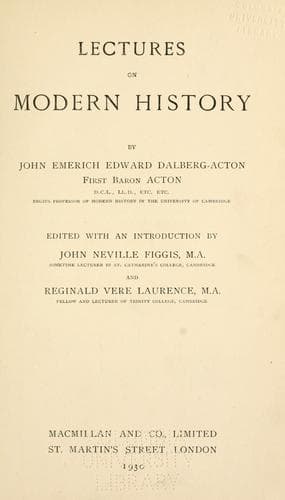
Lectures on Modern historyActon, John Emerich Edward Dalberg Acton, Baron
History
Lectures on Modern history
Acton, John Emerich Edward Dalberg Acton, Baron
History, Modern
It had already been printed from better MSS. by Cardinal Ximenes in
the fifth volume of the Complutensian Polyglot, which did not appear
until 1522. Therefore Erasmus's edition is the first ever
published. It was produced at last, in a hurry, to secure the
priority, and was not greatly improved afterwards. Part of the
Apocalypse was wanting in all his MSS. He restored it by translating
it into Greek from the Vulgate, and in six verses made thirty
mistakes. His second edition had a letter of approbation from Leo X,
and it was the edition which Luther used for his translation. It is a
sign of the want of religious interest in the Renaissance, especially
in Italy, that printing had been going on for sixty years, and 24,000
works issued from the press, some of them more than a hundred times,
before anybody thought of the Greek Testament.
Erasmus occupied his later years with the works of the Fathers, also
printed by Froben, the Greeks in Latin translations. "Letters," he
said, "had remained Pagan in Italy, until he taught them to speak of
Christ." Just as he was entirely destitute of the national fibre, so
too he stood apart from the schools or currents of his time. His
striving was to replace the scholastics by the Fathers, systematic
theology by spiritual religion; and those Doctors of the Church who
inclined to system, such as St. Augustine, repelled him. It may be
said that he was not attracted by St. Paul, and preferred the Gospels
to the Epistles. He esteemed Seneca more highly than many Christian
divines. Although he chose to employ the weapon of irony, and
abstained from the high horse and the big word, he was earnest in his
desire for the reform of abuses in the Church. He disliked
contention, and desired to avoid offence; but he made enemies in all
parts of Europe, and was vehemently denounced by the theologians of
Paris and Louvain, by the Spanish friars, by Archbishop Lee, by
Zuniga, the Count of Carpi, and especially by the very learned
Steuchus of Gubbio. In later days he was one of the first writers put
on the Index. But throughout his career as a divine, that is, for the
last quarter of a century that he lived, he was consistently
protected, defended, consulted by Popes, until Paul III offered him a
Cardinal's hat and desired that he would settle at Rome. He told Leo X
that he thought it a mistake to censure Luther, with whom he agreed as
to many of the matters calling for reform. But whilst Luther
attributed the prevailing demoralisation to false dogmas and a faulty
constitution, Erasmus sought the cause in ignorance and
misgovernment. What came from this division of opinion pertains to the
next lecture. Erasmus belonged, intellectually, to a later and more
scientific or rational age. The work which he had initiated, and which
was interrupted by the Reformation troubles, was resumed at a more
acceptable time by the scholarship of the seventeenth century.
IV
LUTHER
Public-domain text, read in full here on John Shaqi.
Reviews
Reviews
No reviews yet
Be the first to share your thoughts on this work.
Elsewhere in the archive
Join the Discussion
Join the discussion
Sign in to leave a comment or review.
Sign InorCreate an account