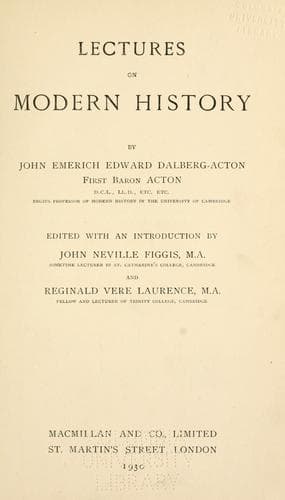
Lectures on Modern historyActon, John Emerich Edward Dalberg Acton, Baron
History
Lectures on Modern history
Acton, John Emerich Edward Dalberg Acton, Baron
History, Modern
DURING THE latter part of the Middle Ages, the desire for reform
of the Church was constant. It was strongest and most apparent among
laymen, for a famous monastic writer of the fourteenth century
testified that the laity led better lives than the clergy. To the
bulk of ordinary Christians reform meant morality in the priesthood.
It became intolerable to them to see the Sacrament administered
habitually by sacrilegious hands, or to let their daughters go to
confession to an unclean priest. The discontent was deepest where men
were best. They felt that the organisation provided for the salvation
of souls was serving for their destruction, and that the more people
sought the means of grace in the manner provided, the greater risk
they incurred of imbibing corruption. In the days when celibacy was
imposed under Gregory VII, it was argued that the validity of orders
depended on conduct; and that idea of forfeiture by sin, essentially
fatal to the whole hierarchical system, was not yet extinct. People
learnt to think of virtue apart from the institutions of the Church,
and the way was paved for a change which should reduce the part of the
clergy in men's lives, and give them families of their own. The hope
that a stricter discipline would be enforced by authority from within
died away. When Eugenius IV directed Cesarini to dissolve the Council
of Basle, the Cardinal replied that if he obeyed they would be thought
to be mocking God and men, and to have abandoned the notion of reform,
and the laity would have some reason to believe that it was a good
deed to destroy, or at least to plunder, the clergy.
The religious influence of the Church was brought low by its record of
failure. The scheme for governing the world by the hierarchy, pursued
for three centuries, had terminated in disaster. For a whole
generation no man knew whether the Papacy was in Italy or in France.
The attempt to effect improvement through the Councils had been
abandoned after many experiments, and the failure to reconcile the
Greeks had established the Ottoman Empire in Europe. With the decline
of the Church the State rose in power and prerogative, and exercised
rights which for centuries had been claimed by the hierarchy. All
this did not suggest Lutheranism to Luther, but it prepared the world
for it.
Public-domain text, read in full here on John Shaqi.
Reviews
Reviews
No reviews yet
Be the first to share your thoughts on this work.
Elsewhere in the archive
Join the Discussion
Join the discussion
Sign in to leave a comment or review.
Sign InorCreate an account