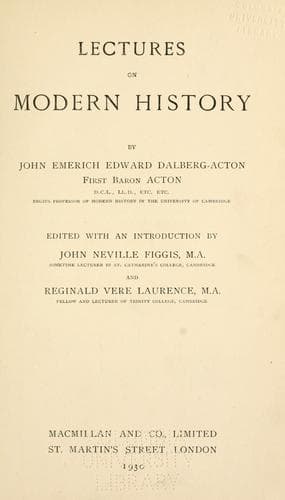
Lectures on Modern historyActon, John Emerich Edward Dalberg Acton, Baron
History
Lectures on Modern history
Acton, John Emerich Edward Dalberg Acton, Baron
History, Modern
Amidst the abuses and excesses of that epoch of lax discipline and
indistinct theology, the point of breaking was supplied by a practice
of very recent growth. Indulgences had long existed, and after a time
they were applied to souls in purgatory. When, at last, plenary
indulgences, that is, total remissions of penalty, were transferred to
the dead, it meant that they were straightway released from purgatory
and received into heaven. Five churches in Rome enjoyed the privilege
that a soul was released as often as mass was said at one of the
altars, technically known as privileged altars, or as often as certain
prayers were said by persons visiting them. There were privileged
altars at St. Peter's, at St. Prassede, at Santa Pudentiana, at the
Scala Santa. At one, five masses were required; at another, thirty.
In the crypt of St. Sebastian one visit was enough. A particular
prayer repeated during forty days remitted one-seventh of the
punishment, and on the fortieth day the dead man would appear to his
benefactor, to thank him. All the benefits available to a pilgrim
visiting Rome could be enjoyed at a distance by the purchase of an
indulgence from the friars sent round to sell them. Such an
indulgence, published by Julius II for the construction of St.
Peter's, was revived by Leo X in 1517, half the proceeds to go to the
Archbishop of Mentz, that he might pay back a loan to Fugger of
Augsburg. The banker's agent went round with the appointed preacher
and kept the strong box. Tetzel, a Dominican, preached the indulgence
in Saxony, though not in the territory of the elector, and he employed
to the utmost the arguments authorised by the custom of the day.
Speaking of him and of his colleagues, Benedict XIV said that they
were the cause of all the trouble that followed.
Many people thought the indulgences, as then practised, a mischief,
because people took them as equivalent to absolution; and the general
of the Augustinians spoke of them as an encouragement to sin. But the
extreme point was the theory that payment of a few pence would rescue
a soul from purgatory. Therefore, when Luther raised a protest
against such propositions, he said no more than what many other people
were saying, and less than some. And he had no idea that he was not
speaking in thorough harmony with the entire Church, or that the
ground he occupied was new. The Dominicans stood by Tetzel and made
his cause their own. They were able to say of him that he had only
uttered current doctrine, though it had not the sanction of former
ages. Three hundred of them were present when he received a degree at
Frankfort on the Oder, and the Dominicans at Rome defended even the
most extreme and grotesque of the sayings attributed to him.
Public-domain text, read in full here on John Shaqi.
Reviews
Reviews
No reviews yet
Be the first to share your thoughts on this work.
Elsewhere in the archive
Join the Discussion
Join the discussion
Sign in to leave a comment or review.
Sign InorCreate an account