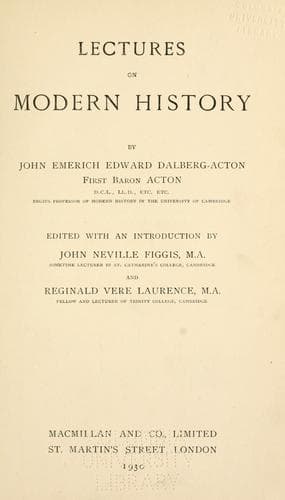
Lectures on Modern historyActon, John Emerich Edward Dalberg Acton, Baron
History
Lectures on Modern history
Acton, John Emerich Edward Dalberg Acton, Baron
History, Modern
A graver personage came upon the scene when it was agreed that Luther
should appear before the Legate at Augsburg. Cardinal Cajetan was the
weightiest divine of the Court of Rome, and a man of original mind,
who was denounced in his order as a dangerous innovator, and whose
writings could not be reprinted without large omissions. He is
commemorated, in political literature, among the advocates of
tyrannicide. He was more dexterous than Prierias, although he also
refused a revision of current practices. By putting forward a decree
of Clement VI, he drove Luther to declare that no papal decree was a
sufficient security for him. So that, having assailed authority in
that which it tolerated or ignored, he assailed it now in that which
it directly affirmed, and was no longer a mere intruder, proffering
unwelcome advice, but a barbarian thundering at the gates of Rome.
Cajetan dismissed him ungraciously; and having been warned that a
Dominican cardinal might be perilous company in the circumstances, he
went off secretly and made his way home. He was already a popular
figure in Germany, and the Diet of Augsburg had complained that the
drain caused by indulgences left no supplies for the Turkish war.
When Luther returned to Wittenberg he was aware that his ideas
extended much farther than he had supposed. Since the refusal to
listen to his remonstrance, he knew that he was involved in a conflict
in which Rome would be against him. He knew also that many of his
countrymen would be on his side. The same discovery was unexpectedly
made by the next papal emissary, Miltitz, a Saxon layman, who was sent
to convey the Golden Rose to Luther's patron, the elector Frederic.
It was well understood at Rome that Cajetan, in pushing Luther one
step beyond his original Thesis, by transferring the question from the
discretion of Tetzel to the authority under which he acted, had
mismanaged the affair. Uncompromising rigour having failed, the
opposite treatment was now applied. Miltitz, finding the majority of
Germans favourable to Luther, deposited the Golden Rose at Nuremberg,
and came into his own country with a resolution to be conciliatory.
The friends whom he saw on his way informed Luther, and urged him to
meet his countryman in the same spirit. Miltitz saw Tetzel and
silenced him; and the inauspicious preacher did not long survive his
disgrace. Having given this proof that he entertained no adverse
prejudice, that on the immediate problem they were in sympathy,
Miltitz had a conference with Luther at Altenburg.
Public-domain text, read in full here on John Shaqi.
Reviews
Reviews
No reviews yet
Be the first to share your thoughts on this work.
Elsewhere in the archive
Join the Discussion
Join the discussion
Sign in to leave a comment or review.
Sign InorCreate an account