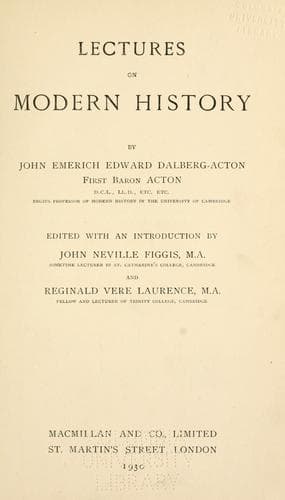
Lectures on Modern historyActon, John Emerich Edward Dalberg Acton, Baron
History
Lectures on Modern history
Acton, John Emerich Edward Dalberg Acton, Baron
History, Modern
Luther at Worms is the most pregnant and momentous fact in our
history, and the problem is to know why he so rigidly repelled the
advances of the confessor, of the Chancellor of Baden, and the Elector
of Treves. Was it simply the compelling logic of Protestantism, or
was there some private saltpetre of his own, a programme drawn from
his personality and habits of mind? There was no question at issue
which had not either been pronounced by him insufficient for
separation, or which was not abandoned afterwards, or modified in a
Catholic sense by the moderating hand of Melanchthon. That happened
to every leading doctrine at Augsburg, at Ratisbon, or at Leipzig.
Predestination was dropped. The necessity of good works, the freedom
of the will, the hierarchical constitution, the authority of
tradition, the seven sacraments, the Latin mass, were admitted.
Melanchthon confessed that he held all Roman doctrine, and that there
was no difference except as to the celibacy of the clergy and
communion under both kinds; the rest was the work of agitators; and he
bitterly resented Luther's tyrannical treatment. As Melanchthon had
the making of the official statements of doctrine, it would almost
appear as if Luther never became a Lutheran. And the truth is that he
held one doctrine which he never succeeded in imposing, and which
forbade all approach and all endeavours to explain. For he believed
that the Pope was anti-Christ. The idea came to him from Lorenzo
Valla, whose tract on the Donation was published in 1518 by Hutten.
He became convinced almost immediately after writing to Leo that
deferential letter which he had agreed upon with Miltitz. It obliged
him to force on a breach at Worms. His main objection to the
Confession of Augsburg was that this article was excluded from it.
Under the malediction of Church and State, Luther was lost sight of
for some months. He was hidden in the Wartburg, the castle of his
Elector, above Eisenach, disguised as a country gentleman. He wore a
moustache, dined joyously, carried a sword, and shot a buck. Although
his abode was unknown, he did not allow things to drift. The
Archbishop of Mentz had been a heavy loser by the arrest of his
indulgence, and he took advantage of the aggressor's disappearance to
issue a new one. He was friendly to Luther, and repressed preaching
against him; and the Elector of Saxony ordered that the controversy
should not be revived. Luther replied that he would destroy the
Elector rather than obey him; the Thesis had been posted in vain, and
the spirit of Tetzel was abroad once more; he gave the Archbishop a
fortnight, after which he would let the world see the difference
between a bishop and a wolf. The prelate gave way, and having
arrested one of his priests, who had married, he consented, at the
reformer's request, to release him.
Public-domain text, read in full here on John Shaqi.
Reviews
Reviews
No reviews yet
Be the first to share your thoughts on this work.
Elsewhere in the archive
Join the Discussion
Join the discussion
Sign in to leave a comment or review.
Sign InorCreate an account